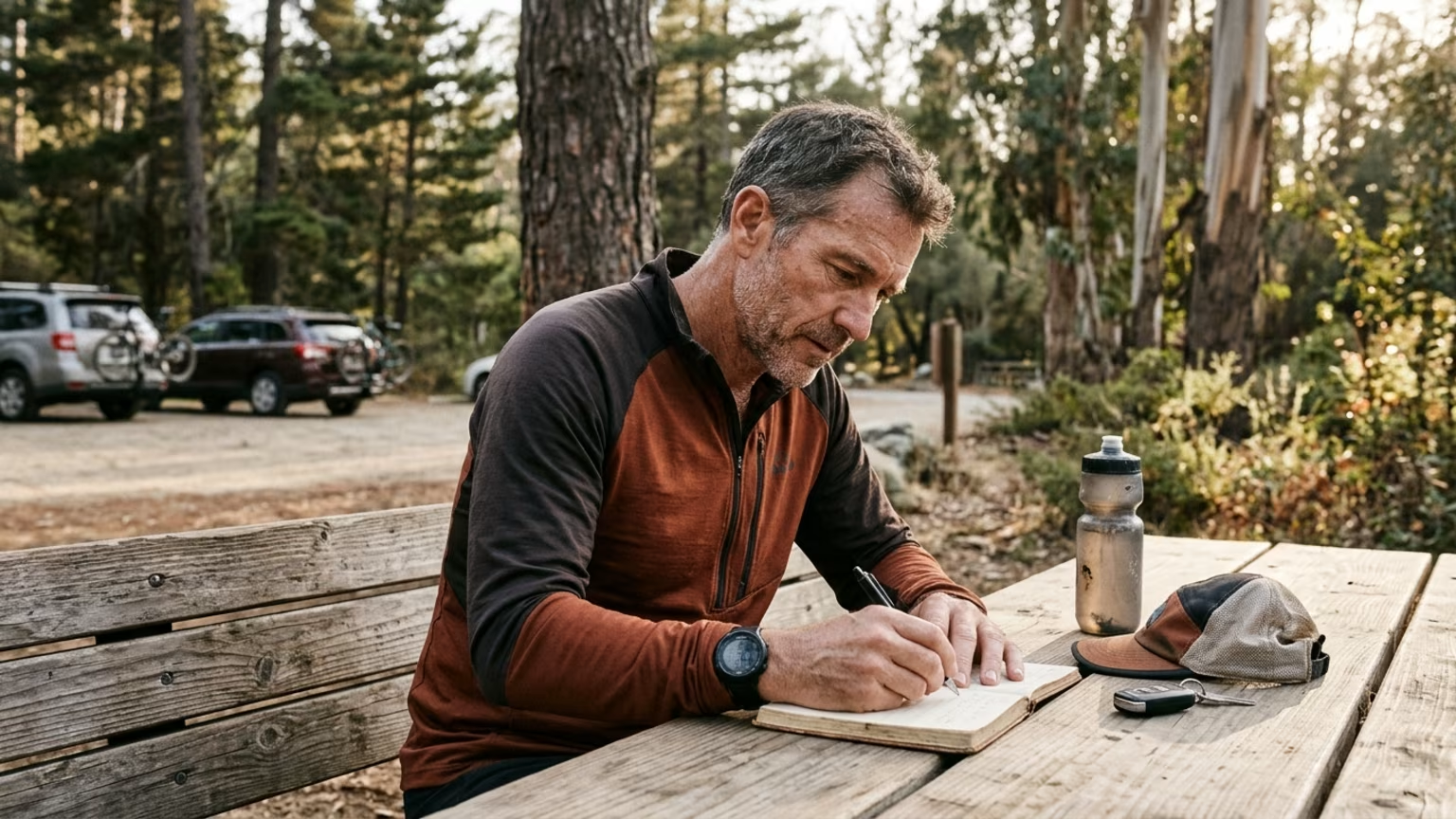

Build an evidence-informed training dashboard with effort, sleep, mood, soreness and workout notes, without letting a score dictate your decisions.





A training dashboard that makes you distrust your own experience is doing the wrong job. More data is not automatically better coaching, and a confident readiness score is not the same thing as a sound training decision.
The useful dashboard is not the one that delivers the firmest verdict. It is the one that puts the workout beside the athlete's experience and leaves room for judgment. Technology belongs in that conversation without becoming the final authority.
For ambitious endurance athletes over 35, that distinction matters to the kind of sporting life Reendure stands for: performing well today while keeping a long future in view. The aim is not to reject measurement. It is to stop confusing measurement with permission.
The appeal of a single score is easy to understand. It offers a tidy answer to an untidy question: am I ready to train? A number seems easier to act on than a mixture of heavy legs and an otherwise reasonable-looking workout record.
But a tidy answer can conceal the question it actually answers. A record of what happened in a session is different from a report of how that session felt. Reendure's preference is to keep those entries visible rather than force them to agree.
The same applies when the signals conflict. If a workout feels unexpectedly difficult despite an encouraging display, that disagreement deserves attention. It is not a contest the device must win. Nor does a difficult feeling automatically explain its own cause.
A restrained dashboard can preserve that uncertainty without becoming useless. It can show what was planned and what was completed. It can also hold a brief account of the experience that the workout record does not describe.
The dashboard also needs a clear job description. If the purpose is to review how a session went, it should make that review easier. If the purpose is to discuss a recurring concern with a coach, it should preserve the relevant notes. A display that keeps changing the question is not necessarily giving a better answer.
The useful distinction is between having access to data and handing it authority. An athlete can welcome the former without accepting the latter.
That is the point of choosing wearable information around a training question, rather than collecting measurements simply because they are available. The question comes first. The display follows.
The strongest lesson from the sleep research here is about interpretation, not a formula for readiness.
A 2026 systematic review of ultramarathon sleep and performance included nine studies involving 2,262 participants. It reported associations between reduced sleep and poorer physical or cognitive performance. Sleep measures were heterogeneous and mostly subjective. Only one included study used wrist actigraphy.
In a study of ultramarathon runners during a training week, researchers did not systematically assess training volume, frequency, intensity or timing. That matters when trying to connect a sleep record with the training that surrounded it.
Those associations do not establish that extending sleep causes faster racing. The training-week study cannot establish that training caused its reported sleep patterns. These sources do not establish a universal readiness score or an age-specific workout adjustment rule. The check-in below is an editorial framework, not a validated protocol.
A useful alternative is a compact log that keeps personal reports beside the workout record. Its purpose is to support reflection and a better conversation with a coach. It does not need to collapse every entry into a total.
No extra points are earned for turning these fields into a complicated calculation. The value is in seeing the entries together while retaining their differences. A note that is easy to understand later serves the purpose better than a precise-looking score whose meaning is unclear.
A useful entry distinguishes observation from explanation. A note such as the session felt harder than usual describes an experience. Adding because my sleep score was low claims a cause that the record has not established.
The distinction is practical. The first statement leaves room to review the session and its context. The second risks closing the discussion before it has started. This framework favors a clear description over a confident explanation.
That also makes the log easier to share. A coach or healthcare professional can see the observation directly rather than first having to untangle a home-made readiness formula. The athlete supplies a record, not a verdict.
For this framework, the reference point is the athlete's own usual pattern. An unusually hard session alongside poorer sleep and mood is a reason to examine the situation. It is not an automatic command to cancel training or push through it.
The review can ask what changed between the plan and the completed session. It can also ask whether the notes describe something isolated or something recurring. That creates a clearer question for a coach without pretending the dashboard has supplied the answer.
Sleep deserves the same treatment. Our approach to putting sleep into the wider training picture is about context rather than chasing a nightly grade. A personal report and a device estimate can remain separate observations.
Persistent or concerning symptoms belong in a conversation with a qualified healthcare professional. A coach can help interpret training choices, but a dashboard should not stand in for medical assessment.
For an athlete over 35, the important question is not whether today's display approves of today's ambition. It is whether the training approach leaves room for continued progress and a lasting racing life. That requires a longer horizon than the next update on a screen.
Reendure's training philosophy puts progressive overload beside recovery. Patience belongs there too. We favor those priorities over short-term promises because our goal includes both immediate performance and staying active for life.
In that framework, the dashboard has a modest but useful role. It helps retain the record of training alongside the experience of doing it. The plan remains the organizing idea rather than being rewritten around every isolated reading.
Progressive overload should not become an argument for ignoring every difficult report. Recovery should not become an exercise in earning an acceptable score. Both deserve deliberate attention within the same plan.
This is why building goals around a longer racing life offers a better frame for the technology. A dashboard is supporting equipment for that project. It is not the project itself.
The standard is practical: does the record help explain the training and support a considered discussion about what comes next? If not, another metric is unlikely to fix the underlying question. A simpler record may be the more disciplined choice.
The next shift worth watching is better interpretation, not simply more measurement. Look for training tools that make their reasoning clearer and preserve the athlete's own account. The desirable change is from issuing verdicts to supporting decisions.
An informative system would distinguish recorded work from reported experience. It would show uncertainty rather than disguise it inside a confident number. It would also make it easy to keep notes beside the data instead of treating them as an afterthought.
One question deserves particular attention: does a tool explain what was measured and what was inferred? Those are different layers of information. Keeping them separate would make the promise of a personal dashboard more credible than simply adding another summary score.
Those are editorial standards to apply to whatever comes next. A new sensor or a more detailed display does not earn authority merely by producing another output. Its usefulness depends on the question it helps the athlete and coach consider.
The dashboard worth keeping will leave space for judgment. It will make the training story easier to read without pretending to write the next chapter on its own.

Follow ReEndure for practical insights on endurance training, recovery, nutrition and healthy aging. Stay connected for new articles, research led guidance and ideas to help you perform better for longer.



Read practical ideas on endurance training, recovery, nutrition and healthy aging to keep progressing for years to come.
Read the Blog