
Enhanced dynamic balance and joint resilience protect runners and cyclists over fifty from trail falls through structured multi-phase neuromuscular protocols.





Why am I suddenly losing my balance on easy trail runs? This is a question many runners and cyclists type into search engines after an unexpected stumble or a near fall on familiar terrain. You have logged decades of miles, your aerobic engine is exceptional, yet your feet feel disconnected from the ground beneath you. This guide provides the definitive answer to why balance declines with age, how it degrades endurance performance, and the exact steps required to rebuild neuromuscular precision.
For masters athletes, the subtle loss of foot control is rarely an issue of muscular strength alone. Instead, it stems from gradual shifts in how the nervous system receives and processes sensory information. When you run, cycle, or hike, your body relies on constant feedback loops between your joints, eyes, inner ear, and brain. If these signals slow down, your efficiency drops and your risk of acute injury increases.
Proprioception is the internal sense of where your limbs are in space. In endurance sports, every stride is essentially a series of controlled single-leg landings. If your stabilizing muscles cannot react instantly to uneven pavement or rocks, you lose forward momentum. Restoring this pathway is critical for your immediate race times and your long-term independence.
You can rebuild this sensory network through structured neuromuscular training. We will break down the precise mechanics of balance, the physiological changes that occur past age fifty, and practical daily exercises to restore stability. Building reliable balance protects your joints, preserves your movement economy, and keeps you moving smoothly for decades to come.
Maintaining equilibrium during movement requires the integration of three distinct sensory systems. The central nervous system continuously gathers data from the visual system, the vestibular system in the inner ear, and the somatosensory system across the body. When all three inputs match, your brain executes smooth motor commands. If one system degrades, balance immediately suffers.
The visual system provides reference points regarding the horizon, terrain changes, and upcoming obstacles. Endurance athletes often rely heavily on visual cues to maintain stability during fast movement. When running in low light or cycling through dappled shadows, visual processing becomes less reliable. If your other sensory systems are underdeveloped, your risk of tripping rises dramatically.
The vestibular apparatus, located within the inner ear, detects head position and motion relative to gravity. It consists of the semicircular canals and otolith organs, which sense angular and linear acceleration. This system ensures your gaze remains stable while your head moves during running or cycling. As we age, the number of sensory hair cells inside these canals decreases, leading to subtle delays in spatial awareness.
The somatosensory system relies on thousands of specialized mechanoreceptors embedded in muscles, tendons, ligaments, and skin. Muscle spindles detect changes in muscle length, while Golgi tendon organs monitor tension. Joint capsules and plantar skin contain Ruffini endings and Pacinian corpuscles, which sense pressure, vibration, and joint angle. Together, these receptors form the foundation of athletic proprioception.
The physical decline in balance with aging is primarily driven by changes within the peripheral and central nervous systems. Starting around age forty, the human body experiences a gradual loss of myelinated nerve fibers. Myelin is the protective sheath that allows electrical impulses to travel quickly along nerve pathways. When myelin degrades, sensory transmission to the spinal cord and brain slows down.
At the same time, the absolute density of cutaneous mechanoreceptors in the soles of the feet decreases. Studies in clinical neurology demonstrate that older adults have higher tactile thresholds, meaning the bottom of the foot needs more pressure to register contact with the ground. In endurance running, this delay means your foot touches down before your spinal reflexes can fully brace the ankle. The result is joint instability, energy loss, and compensatory muscle strain.
Research in the journal Sports Medicine highlights that age-related motor unit loss disproportionately impacts fast-twitch fibers. These type II motor units are responsible for rapid, reactive force production when you trip or slip. If a trail runner hits a loose stone, fast-twitch fibers must fire within milliseconds to correct foot placement. Slower recruitment means the ankle rolls before corrective torque can be applied.
In our experience working with aging endurance athletes, many mistake this sensory latency for simple muscular fatigue. They assume their legs are tired, when in reality their neuromuscular control loops are lagging. You can learn more about how nervous system fatigue influences tissue health in our injury prevention resources library. Targeted balance training reactivates these dormant motor pathways, restoring fast reflex loops.
Endurance running is not a two-legged activity. It is a continuous sequence of single-leg hops, where each foot strike absorbs two to three times your body weight. During the stance phase, your entire skeleton depends on the lateral hip and lower leg to maintain alignment. If the gluteus medius fails to stabilize the pelvis, the knee collapses inward, a flaw known as dynamic valgus.
This biomechanical breakdown wastes metabolic energy. When your pelvis drops during running, your body must spend extra muscular effort to pull itself upright for the next stride. Over a marathon, these microscopic lateral corrections cost minutes of performance and wear down cartilage. Stable single-leg balance keeps your force vectors directed straight ahead, maximizing your running economy.
Cycling presents a different balance challenge that is often overlooked. While the bike provides external support, pedal stroke efficiency relies entirely on unilateral hip and ankle stability. If your foot wobbles across the pedal stroke, power transfer through the metatarsal head is compromised. Cyclists with poor proprioception frequently suffer from medial knee pain due to inconsistent lateral tracking under heavy loads.
Furthermore, proper single-leg control reduces excessive reliance on passive connective tissues. When the dynamic muscular stabilizers fail to react, the plantar fascia, Achilles tendon, and iliotibial band absorb the excess stress. Over time, this repetitive strain leads to chronic overuse injuries that halt training. Restoring active proprioceptive control shields these vulnerable structures from unnecessary wear.
Pavement provides a predictable, uniform surface where sensory feedback requirements remain relatively constant. In contrast, trail running forces the neuromuscular system to adapt with every single step. Variable gradients, exposed tree roots, loose gravel, and mud require continuous micro-adjustments in foot strike angle and stiffness. For athletes over fifty, these environments immediately expose any underlying balance deficits.
When running uphill on technical trails, your center of mass shifts forward, demanding rapid engagement of the intrinsic foot muscles. On descents, ground reaction forces spike, and the ankle joint must manage high-velocity rotational forces. If your mechanoreceptors cannot instantly signal the degree of slope, your braking forces increase. This protective braking rapidly fatigues the quadriceps and strains the patellar tendon.
Fatigue exacerbates sensory deficits exponentially. As central fatigue sets in during the late stages of an ultra-marathon or long trail run, cognitive processing slows down. The brain becomes less capable of compensating for delayed peripheral signals from the feet. This explains why the vast majority of falls and severe ankle sprains happen in the final third of a long training run.
Athletes who dedicate time to reactive stability drills build a protective buffer against this late-race fatigue. By making balance adjustments automatic at the spinal level, you spare higher cortical brain centers from constant micro-management. This preserves mental clarity for pacing, hydration, and tactical decisions on the trail. You can review strategies for managing long efforts in our endurance performance resources section.
Beyond immediate athletic performance, proprioceptive training serves as critical insurance for your future quality of life. According to the Centers for Disease Control and Prevention, falls are the leading cause of injury-related death and hospitalization among older adults. While an active fifty-year-old may feel far removed from these statistics, the neuromuscular changes that lead to falls begin decades before the first serious incident occurs.
A fall later in life often initiates a dangerous cascade of physical decline. Fractures of the hip or pelvis require prolonged bed rest, which accelerates muscle loss, also known as sarcopenia. For a dedicated runner or cyclist, several months of immobility can permanently reduce aerobic capacity and functional independence. Maintaining razor-sharp balance is just as vital as maintaining a high VO2 max.
Endurance athletes often assume their high cardiovascular fitness automatically protects them from balance-related falls. Unfortunately, linear sports like road running and cycling only train movement in the sagittal plane. They do not sufficiently challenge lateral stability, rotational control, or sudden multi-directional recovery steps. True functional longevity requires varied, multi-planar movement patterns.
By investing five to ten minutes daily in deliberate balance work, you reinforce the neuromuscular reflexes that prevent trips from becoming catastrophic falls. You build the capacity to execute a rapid lateral step if your foot catches an edge. This athletic resilience allows you to pursue aggressive endurance goals well into your seventies while protecting your everyday mobility. For comprehensive longevity guidance, visit our healthy aging resources hub.
Restoring balance requires consistent, progressive stress on the sensory triad. You do not need expensive gym machines to make rapid gains. Instead, you should progress from static, stable environments to dynamic, unpredictable movements. Perform these exercises barefoot whenever possible to maximize sensory input to the plantar mechanoreceptors.
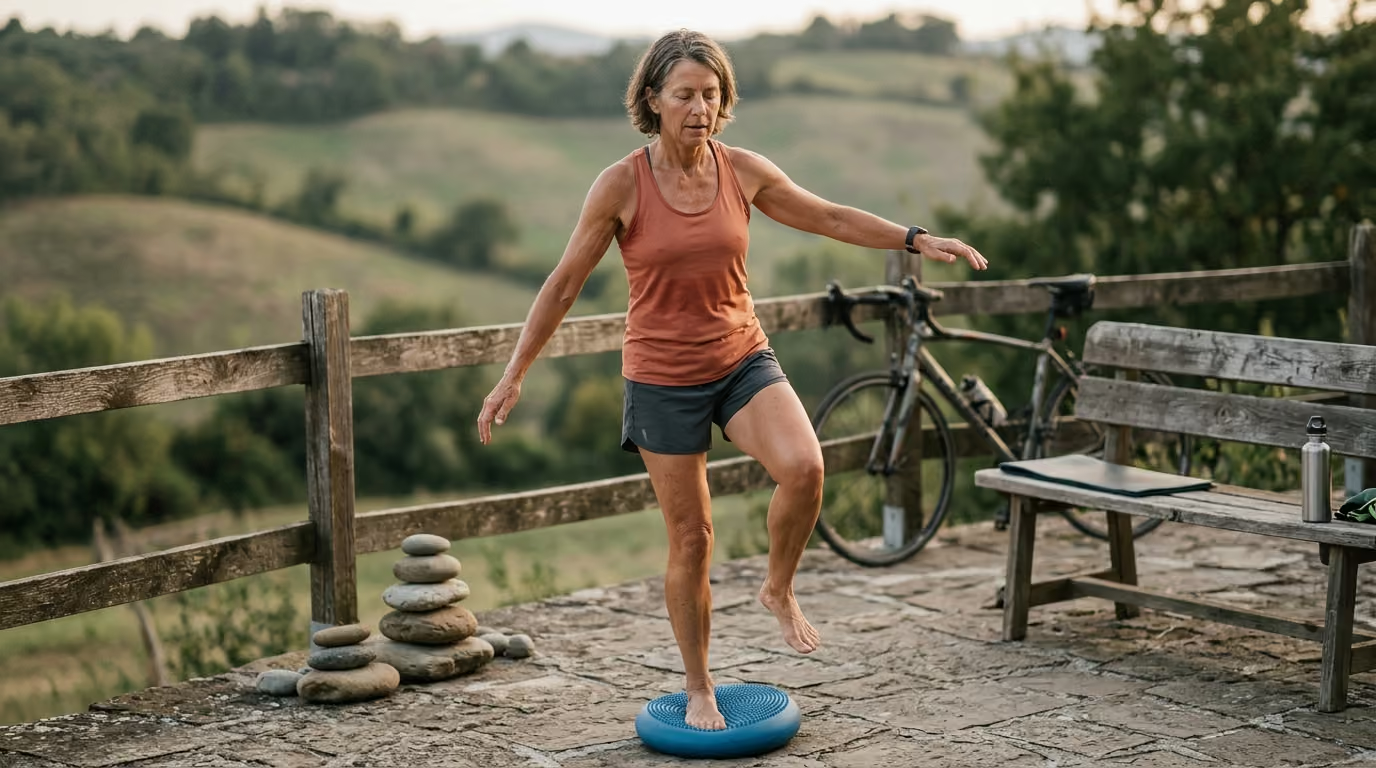
Begin with foundational static balance drills that remove visual support. Stand barefoot on one leg on a firm, flat surface with your hands on your hips. Keep the standing knee slightly unlocked to engage the quadriceps and calf dynamically. Hold this position for thirty seconds without allowing the elevated foot to touch the floor or your pelvis to tilt.
Once you can easily hold this position for thirty seconds, close your eyes. Removing visual input forces your brain to rely entirely on vestibular and somatosensory feedback. You will immediately feel the muscles in your foot and ankle working intensely to make micro-adjustments. Aim for three sets of thirty seconds per leg, resting thirty seconds between efforts.
After mastering static balance, introduce movement to simulate the dynamic forces of running. The Single-Leg Romanian Deadlift (RDL) is one of the most effective drills for endurance athletes. Standing on your left leg, hinge forward at the hips while extending your right leg straight behind you. Keep your spine neutral and your hips square to the floor, then return to an upright position using your glutes.
Another essential movement is the Star Excursion balance drill. Imagine standing in the center of an eight-pointed star drawn on the floor. While balancing on your left leg, reach your right foot out as far as possible to touch points at the front, side, and rear. Tap the floor lightly with your toes without transferring your body weight, then return to the center. Perform five complete circuits on each leg.
The final progression involves reacting to unpredictable external forces. Stand on one leg on a balance pad or foam cushion while a partner throws a light medicine ball or tennis ball toward you. Catch and return the ball while maintaining your single-leg stance. Throwing the ball slightly off-center forces your deep stabilizing muscles to react to unexpected shifts in your center of mass.
If training alone, perform lateral bound-and-stick drills. Jump sideways off your right foot, land softly on your left foot, and immediately freeze your position for two full seconds. Absorb the impact through your hip, knee, and ankle without letting your knee cave inward. Repeat this movement back and forth for ten repetitions per side, focusing on quiet, controlled landings.
Athletes over forty and fifty must account for structural changes in connective tissues when designing a balance regimen. Tendons and ligaments lose water content and elasticity as we age, reducing their capacity to absorb sudden shocks. High-impact plyometric balance drills must be introduced gradually to avoid aggravating the Achilles tendon or plantar fascia.
Furthermore, joint range of motion often diminishes with age, particularly in the ankle joint. Restricted ankle dorsiflexion severely compromises single-leg stability by forcing the knee and lower back to compensate. Before performing balance exercises, spend several minutes mobilizing the calves and the talocrural joint. Adequate ankle mobility gives your mechanoreceptors the mechanical freedom to function properly.
Recovery rates also change as we age. Neuromuscular training places a unique demand on the central nervous system, even if it does not leave your muscles feeling sore. Performing complex balance drills when you are deeply fatigued from a heavy training block increases your risk of poor movement patterns. Schedule your dedicated proprioception sessions on easy recovery days or before hard workouts when your nervous system is fresh.
Nutrition plays an equally vital role in supporting neurological health. Adequate intake of essential fatty acids, vitamin B12, and quality protein supports nerve conduction velocity and muscle repair. In our experience, older athletes who dial in their daily nutrition recover faster from both aerobic sessions and neuromuscular drills. For specific fueling protocols, explore our nutrition and fueling resources page.
For years, I capped my mid ride fueling at around sixty grams of carbs per hour, convinced that taking in more would wreck my stomach. Then I read a series of recent studies on gut training and higher oxidation limits for endurance athletes. I spent a three month base phase gradually increasing my intake up to ninety grams using a mix of glucose and fructose. The difference during my next Gran Fondo was staggering. I had a late race surge that I had never experienced before, completely avoiding the usual energy crash.
The shoes you wear during daily life and training have a profound impact on proprioceptive function. Highly cushioned running shoes with thick, rigid foam midsoles act as sensory filters. While they attenuate impact forces, they also block your plantar mechanoreceptors from sensing fine details about the ground surface. Over time, reliance on ultra-cushioned shoes can dull natural foot reflexes.
Rigid arch supports and custom orthotics can also alter natural balance mechanics. While orthotics are valuable tools for managing acute structural injuries, wearing them continuously can weaken the intrinsic muscles of the foot. The foot contains four distinct muscular layers that support the medial longitudinal arch. If an external insert supports the foot entirely, these intrinsic muscles lose their strength and sensory responsiveness.
Masters athletes should consider incorporating intentional barefoot time into their weekly routine. Walking barefoot on grass, carpet, or textured surfaces stimulates dormant cutaneous mechanoreceptors. You do not need to switch entirely to minimalist running shoes to gain these benefits. Simple lifestyle adjustments, like spending thirty minutes barefoot at home each day, provide substantial sensory re-education.
When choosing running shoes, look for models that balance protection with ground feel. A shoe with a wide toe box allows your toes to splay naturally upon impact. This splay expands your base of support and allows the big toe, or hallux, to anchor your balance during the push-off phase. Stifling the toes inside a narrow toe box directly destabilizes your single-leg stance.
The most common error athletes make when starting balance training is moving to unstable surfaces too quickly. Standing on a wobble board or foam pad before mastering solid ground mechanics creates poor compensation patterns. If you cannot maintain a stable arch on a flat floor, adding an unstable surface only reinforces bad habits. Build a solid baseline on firm ground before adding complex tools.
Another frequent mistake is holding your breath during balance drills. When balance is challenged, athletes often tense their upper body, lock their diaphragm, and hold their breath to create artificial stability. This strategy is useless during endurance sports, where you must maintain stability while breathing heavily. Focus on slow, rhythmic diaphragmatic breathing during every balance exercise.
Athletes also tend to treat balance as an afterthought, tacking it onto the end of an exhausting two-hour run. When your nervous system is depleted, your mechanoreceptors fire slowly, and your coordination drops. Practicing balance under extreme fatigue reinforces sloppy mechanics rather than building sharp reflexes. Dedicate ten focused minutes at the start of your strength sessions instead.
Finally, many runners focus exclusively on the ankle while ignoring the hip complex. True stability is top-down as well as bottom-up. A weak gluteus medius causes the entire leg to collapse inward, regardless of how strong your ankles are. Balance training must challenge the entire kinetic chain, linking foot mechanics directly to core and pelvic control.
Tracking your balance improvements provides tangible motivation and ensures your training is working. You can use several validated sports science tests at home with nothing more than a stopwatch and a piece of tape. Perform these assessments every four weeks to measure your progress objectively.
The Timed Single-Leg Stance Test with Eyes Closed is a gold-standard baseline. Stand barefoot on a hard floor, cross your arms over your chest, lift one foot, and close your eyes. Start the timer immediately. Stop the clock when your standing foot moves, your hands leave your chest, or your non-standing foot touches the floor. Athletes over fifty should target a minimum of twenty seconds per leg.
The Y-Balance Test assesses dynamic balance, strength, and neuromuscular control. Place three strips of tape on the floor: one extending forward, and two extending backward at 135-degree angles, forming a "Y" shape. Balancing on one foot at the intersection, reach your other foot as far as possible along each tape line without touching down heavily. Measure the reach distance in centimeters and compare both legs.
A reach asymmetry greater than four centimeters between your left and right leg indicates a significant neuromuscular deficit. This imbalance often points to a prior injury that never fully rehabilitated. By identifying these asymmetries early, you can direct extra training volume to your weaker side before it causes an overuse injury during your racing season.
Integrating balance training into a busy endurance schedule does not require hours of extra gym time. By establishing small, repeatable daily habits, you can rapidly upgrade your sensory processing systems. Follow this actionable checklist to structure your weekly routine.

Follow ReEndure for practical insights on endurance training, recovery, nutrition and healthy aging. Stay connected for new articles, research led guidance and ideas to help you perform better for longer.


Read practical ideas on endurance training, recovery, nutrition and healthy aging to keep progressing for years to come.
Read the Blog