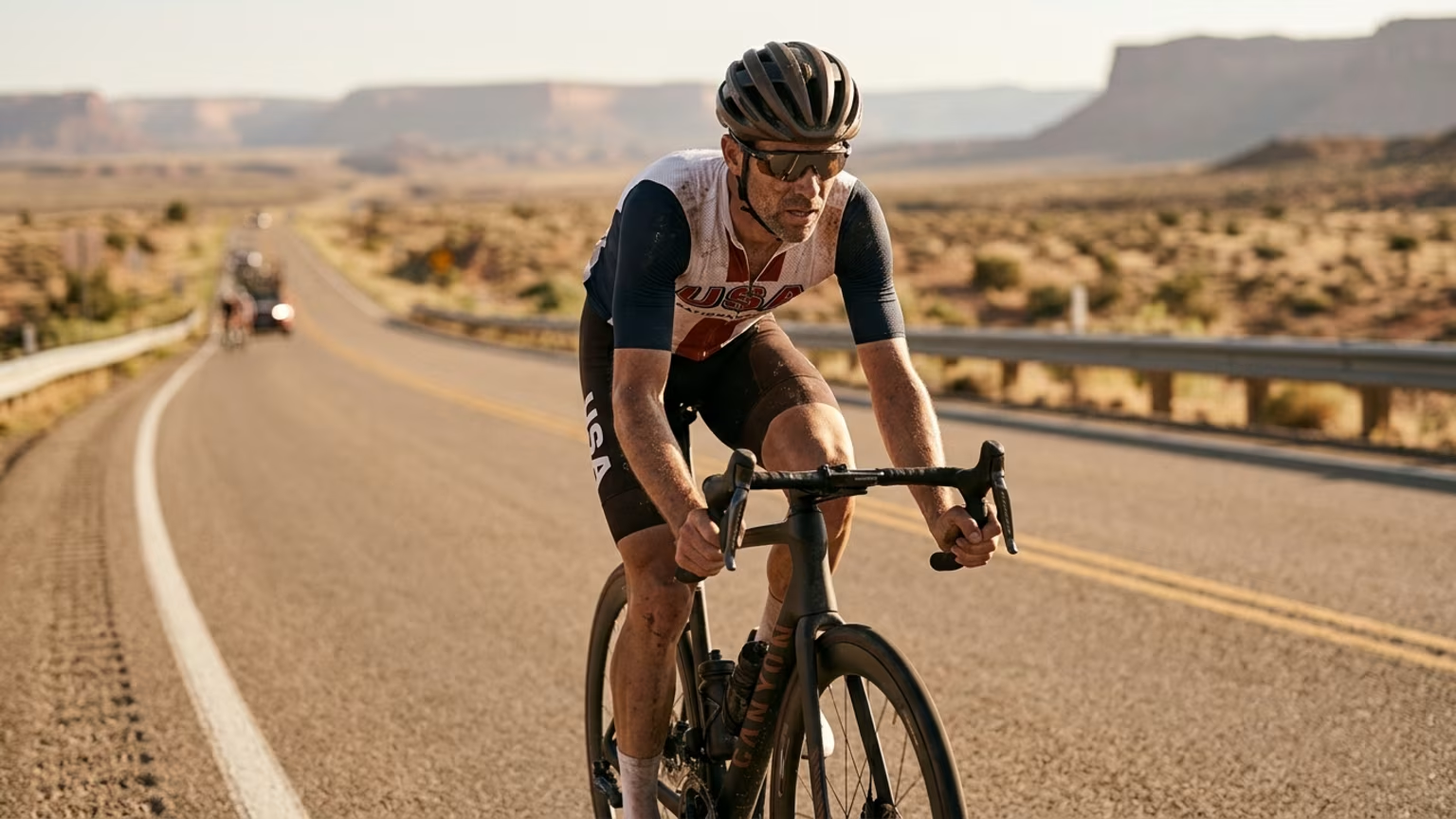

Review the tactical lessons from Brandon McNulty's 2026 UCI World Championship victory. See how veteran athletes can apply these late race pacing strategies.





On September 27, Brandon McNulty won the men’s elite road race at the 2026 UCI Road World Championships in Montréal. The result ended a thirty three year wait for a United States men’s elite road race world title. According to Reuters, the twenty eight year old rider secured the victory after a demanding day of racing. McNulty finished the event with a thirteen second advantage over a fractured chase group.
Michael Matthews took second place in a sprint finish. Mathieu van der Poel finished third and also crossed the line thirteen second behind the winner. This race provides a clear look at decisive late race positioning. The victory did not come down to a predictable group sprint among the pre race favorites.
Instead, event coverage described a race defined by multiple attacks and a frantic late chase. A world championship road victory offers practical examples of energy conservation and tactical execution. The reporting supplies a useful tactical case study for experienced endurance athletes. We can observe how elite riders manage long distance positioning during major events.
While the result is a historical milestone for American cycling, its real value lies in the race dynamics. Understanding these dynamics helps us analyze our own competitive habits.
The defining moment of the championship occurred when the riders were already heavily fatigued. Race coverage from FloBikes reported that McNulty went clear with roughly thirty two to thirty three kilometers remaining. This was a significant solo move launched late in a grueling competition. He attacked while the leading contenders were watching one another closely.
This hesitation among the favorites allowed McNulty to quickly build an advantage. He then sustained his solo effort as the chase group desperately tried to organize behind him. The primary takeaway from the event coverage centers on the dynamics of hesitation. The leading contenders focused heavily on marking each other instead of maintaining a high pace.
Their reluctance to take immediate control created a distinct window of opportunity. McNulty recognized this hesitation and fully committed to a sustained solo effort. While the chasers contested the remaining podium places, the leader stayed clear to the finish. Matthews won the sprint for silver while Van der Poel settled for bronze.
The reporting gives no evidence that a specific training plan caused this victory. The available reports do not provide power data or internal physiological measurements. We cannot explain the effort strictly in sports science terms. Instead, the result illustrates that a late solo move can succeed in a major championship event.
It proves the effectiveness of taking control when rivals falter under pressure. This tactical boldness is a skill that any ambitious rider can study and appreciate.
The physical demands of the Montréal course were immense. The championship event covered two hundred and seventy three point four kilometers. McNulty completed this massive distance in six hours, seventeen minutes, and four seconds. The sheer duration of this event places extreme stress on the aerobic system.
Sustaining a high output after six hours of racing requires exceptional fatigue resistance. It is important to view this result strictly as an observational case study. The primary source material for this analysis relies on live race reporting. Live coverage provides a narrative of events rather than a rigorous physiological analysis.
We do not have access to independently controlled sports science data for this effort. We only have the official finish times and observed tactical decisions to evaluate. One race cannot establish that attacking from distance is universally superior to waiting for a sprint. The strategy worked brilliantly on this specific day, but racing is inherently unpredictable.
Furthermore, elite championship tactics differ greatly from amateur age group events. Professional riders have dedicated team support and entirely different physiological profiles. They spend years optimizing their bodies for the unique demands of international competition. This result should not be framed as a direct training prescription for recreational or masters riders.
The event coverage does not test a training intervention or a specific fueling protocol. It simply records the outcome of a highly competitive international sporting event. We must treat the outcome as an example to discuss rather than a blueprint to copy. The true value lies in the broader lessons about decision making under pressure.
For an ambitious adult racer, the most defensible takeaway is tactical rather than physiological. We often focus obsessively on threshold power and structured interval data in our training. However, raw fitness only matters if you deploy it at the correct moment during an event. Observing how a race changes when contenders hesitate offers a highly valuable lesson.
A rider’s move can create a massive advantage while others are simply waiting to react. Many age group athletes fall into the trap of passive racing. They wait for others to dictate the pace or simply hope to survive until the final kilometer. This passive approach often leads to predictable and easily countered race strategies.
The lesson here involves questioning your own positioning and the risks of waiting. When you let your rivals control the tempo, you surrender your tactical agency. Recognizing hesitation in a pack allows you to dictate the outcome on your own terms. This requires the confidence to commit to a hard effort when others are looking around.
Executing a late race attack requires a specific type of physiological resilience. You need the muscular endurance to surge when your legs are already heavily fatigued. Developing this capability requires careful planning and a mature approach to progressive overload. As we age, our bodies require more deliberate management of intense training loads.
Hitting my forties brought a harsh reality check. The track workouts were not getting slower, but the days after them felt significantly heavier. Instead of forcing my old Tuesday and Thursday intensity schedule, I looked at the data on Masters athletes and muscle protein synthesis. I pushed my second hard session to Friday, allowing an extra forty eight hours of low intensity recovery.
My total weekly volume stayed the same, but the quality of my intervals skyrocketed. This shift in recovery allowed me to generate much higher top end power during late race simulations. Building that deep fatigue resistance requires respecting the body's fundamental need to rebuild. If you want to launch a decisive attack after hours of racing, you must train smart.
You must arrive at that critical moment adequately recovered from your preceding training blocks. The ability to execute tactically is directly tied to managing cumulative fatigue. We can see parallels in other demanding endurance disciplines across the sporting landscape. Understanding these dynamics helps athletes navigate the hardest parts of their season.
For example, athletes can draw fatigue management lessons from the 2026 Tor des Géants when planning their recovery. If your training leaves you perpetually depleted, you will lack the sharpness to exploit tactical openings. The structure of elite championship racing dictates post race recovery protocols that everyday athletes can adapt. We can apply these elite observations to our own event preparation strategies.
Similar tactical insights apply to runners seeking pacing lessons from the 2026 World Athletics Road Running Championships. While we may not race for a world title, we can certainly approach our events with sharper tactics.
Veterans of endurance sports know that the final quarter of any long event is uniquely brutal. The aerobic engine is strained, and the central nervous system is heavily compromised. Decision making often becomes impaired as physical exhaustion fully sets in. This is precisely why practicing late race scenarios in training is so crucial.
If you only practice your sprints on fresh legs, you are completely unprepared for real competition. You must condition your mind to stay alert when your body wants to shut down. Recognizing the subtle shifts in pack dynamics can make a huge difference in your final standing. Watch for the moments when the pace unexpectedly drops or when riders stop taking pulls.
These lulls are the precise tactical windows that aggressive riders successfully exploit. It takes courage to break away, but the alternative is leaving your result to chance. You can purposefully structure your training to simulate these specific late race demands. Incorporate sharp surges at the very end of your longest endurance days.
Teach your body to accelerate even when muscle glycogen stores are running dangerously low. This approach bridges the gap between purely physiological fitness and practical race day execution. The most successful veteran athletes blend a deep aerobic base with sharp tactical awareness. Understanding the dynamics of a late attack also helps you defend against one.
If you recognize that the group is hesitating, you can anticipate an opponent's upcoming move. You can position yourself near the front to respond immediately to any sudden acceleration. Proactive racing is always more energy efficient than reactive scrambling at the back. The mental discipline required to launch a solo move is often overlooked.
When you attack from distance, you are entirely exposed to the wind and to self doubt. There is no one to pace you, and there is nowhere to hide if you fade. This mental toughness is cultivated through repeated exposure to discomfort during long training sessions. Building this psychological resilience is just as critical as logging weekly mileage.
It requires deliberate practice when the natural instinct is to slow down. Ambitious adults must intentionally seek out these moments of friction in their preparation. Accepting that friction ultimately makes race day execution feel familiar rather than overwhelming. The tactical lessons from Montréal remind us that endurance racing is a dynamic puzzle.
Endurance athletes must learn to recognize tactical hesitation and possess the late race resilience to act decisively when the group falters.

Follow ReEndure for practical insights on endurance training, recovery, nutrition and healthy aging. Stay connected for new articles, research led guidance and ideas to help you perform better for longer.



Read practical ideas on endurance training, recovery, nutrition and healthy aging to keep progressing for years to come.
Read the Blog