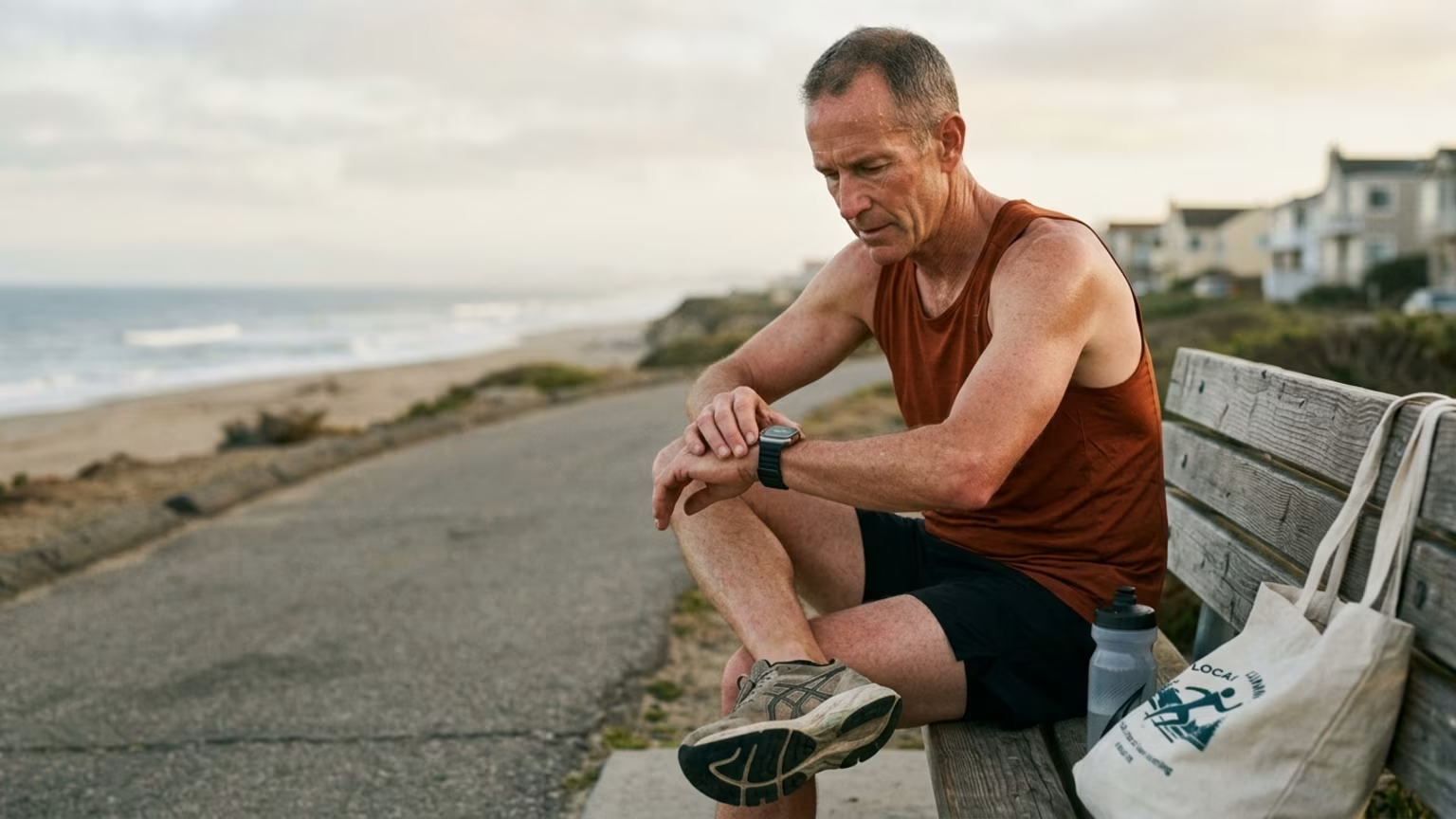

Apple Watch Series 12 and Ultra 4 introduce a dynamic Readiness score based on HRV, sleep, and training load. Discover how endurance athletes can use this tool.





On September 21, 2026, Man of Many published an in-depth interview with Apple representatives Cait Dooley and Craig Bolton. The discussion detailed how the new Readiness feature on Apple Watch Series 12 and Apple Watch Ultra 4 translates complex biometric data into daily training guidance. Starting at AUD$649 for the Series 12 and AUD$1,399 for the Ultra 4, these wearables attempt to simplify how athletes monitor their physical capacity. The official Readiness app requires iOS 27 or later on an iPhone and watchOS 27 or later on the watch.
Apple’s Readiness feature generates a daily score from 0 to 10. It categorises the user into one of four distinct states: Recover, Pace Yourself, Ready, or Go For It. The system assesses recent activity, overnight vitals, and sleep patterns to determine this daily capacity. According to the interview, the software builds an individual baseline for each user to contextualise the current reading.
This baseline relies on multiple historical and physiological variables. Inputs include historical sleep quality, overnight recovery HRV, daytime heart rate, and overall daily activity. Cait Dooley noted that the system is personalised to the individual rather than relying solely on generic activity targets. In previous iterations, wearable fitness often focused heavily on whether an athlete had successfully closed their daily activity rings.
The new software attempts to distinguish between a demanding interval session and a light recovery spin. These two activities represent completely different physiological stresses on the body, even if both successfully close an activity ring. The algorithm accounts for this difference by evaluating workout intensity alongside cumulative training load. It also considers passive activity that occurs simply while wearing the watch, such as walking around an office or attending a family event.
A defining characteristic of the Readiness score is its dynamic nature. The number is not permanently fixed when an athlete wakes up in the morning. The score can shift later in the day after an intense workout, a nap, or an unusually elevated daytime heart rate. Craig Bolton described the score as something that may shift slightly after significant activity.
Apple designed the interface to provide a simple headline score alongside the option to investigate contributing factors. Users can tap into the interface to see whether poor sleep or suppressed HRV caused a lower result. The official listing also emphasises glanceable access through complications and Smart Stack widgets. This design places the shifting guidance directly on the watch face before a workout.
The Readiness app is currently listed as “Only for Watch” in the App Store. The official listing notes that the application has not yet received enough ratings or reviews to display a meaningful public user-rating record. Despite the lack of public reviews, Man of Many reported that Apple tested its new heart-rate sensors against leading wearables in a study involving more than 1,000 participants. According to the publication, Apple claims these sensors achieved the highest accuracy across the tested devices.
The hardware supporting this feature includes Apple’s S11 chip, a redesigned optical sensor, and a redesigned electrical sensor. The frequency of data collection from these sensors is dense and continuous. The watch samples heart rate every five seconds during standard use. It also measures recovery heart-rate variability at night at intervals of up to every five minutes to feed the scoring algorithm.
Craig Bolton mentioned that Readiness could help a marathon athlete understand how to adjust or augment their training. For older athletes managing a strict recovery budget, this concept of continuous load adjustment is highly relevant. However, Man of Many explicitly stated that the article contains no specific reference to masters athletes or age-specific Readiness guidance. We must view this as a general decision support feature rather than a validated protocol for older adults.
Managing high intensity becomes the primary operational challenge for ambitious endurance athletes over 35. Hitting my forties brought a harsh reality check. The track workouts were not getting slower, but the days after them felt significantly heavier. Instead of forcing my old Tuesday and Thursday intensity schedule, I looked at the data on Masters athletes and muscle protein synthesis.
I pushed my second hard session to Friday, allowing an extra forty eight hours of low intensity recovery. My total weekly volume stayed the same, but the quality of my intervals skyrocketed. Wearable algorithms provide secondary validation for this type of structural adjustment. When a device repeatedly flags a suppressed recovery state after speed work, it confirms the physical need for extended rest periods.
For an athlete balancing intense physical training with demanding professional work, travel schedules, and inevitable sleep disruption, this broader context is vital. It offers a more holistic view than a metric that only measures workout duration. Athletes can use these daily metrics alongside an endurance athlete race day readiness framework to make sensible programming compromises. The four Readiness classifications offer a practical structure for these ongoing adjustments.
A "Recover" score of 0 to 2 suggests prioritising rest, quality sleep, or very light active recovery. For a veteran athlete, this means replacing a planned hard workout with an easy walk or light mobility work. Ignoring a low score consistently often precedes an overuse injury or an extended period of lingering fatigue.
A "Pace Yourself" score of 3 to 5 indicates that activity should remain light and controlled. Athletes should avoid turning an ordinary endurance session into an unplanned threshold test on these days. A "Ready" score of 6 to 8 means the body is suitable for normal daily activity and standard workouts. You can continue with your normal training plan while still factoring in your own subjective soreness.
A "Go For It" score of 9 to 10 indicates the best conditions for a harder training session. However, these high classifications simply offer permission to consider a hard session rather than proof that the workout will yield a personal best. Athletes still need to verify that they feel well and that the high intensity fits the broader architecture of their week.
Relying entirely on wearable algorithms carries inherent risks for endurance athletes. A secondary review by Kovr Coach notes that HRV can respond to heat, illness, alcohol, and travel alongside general training load. This broad responsiveness makes it difficult to identify the precise cause of a change from HRV alone. A composite score combining sleep, heart rate, and training load inherits these exact same limitations.
The Kovr Coach analysis provides important nuance regarding the hardware measurements that feed these scores. The review argues that overnight wrist-based HRV can show reasonable agreement with reference measurements under appropriate testing conditions. However, it notes that sleep-stage estimates from wrist wearables are generally weaker. This distinction matters because Apple’s Readiness algorithm relies heavily on both HRV and sleep data.
If the underlying sleep-stage estimate is inaccurate, the composite score may offer flawed guidance. Furthermore, the feature should never be treated as a clinical medical diagnosis. Apple’s public description carefully frames the software as a way to understand daily capacity and classify training readiness. It is not designed to serve as a clinical assessment of disease, medical overtraining syndrome, injury risk, or cardiovascular safety.
A low Readiness result is a prompt to investigate your recovery, not an automatic diagnosis of overtraining syndrome. The Kovr Coach analysis also points out that composite readiness scores lack independent peer-reviewed validation against actual performance outcomes. Apple has not published the specific mathematical formula or the numerical weighting assigned to each input in its algorithm. This technology works best as a daily load management conversation rather than a rigid set of rules.
We see this shift toward interpreted guidance across the entire sports technology sector. As competitors expand their own flagship performance smartwatch lineups, the emphasis is moving away from raw data points. Instead, these devices aim to offer a simplified interface for considering multiple recovery signals simultaneously without overwhelming the user.
This simplification is useful, but the user still has to apply critical judgement and recognise the limits of the hardware. The strongest approach is looking for repeated patterns across several consecutive days. Combine the device data with a detailed training diary, regular coach input, and honest self assessment. This multifaceted approach is essential when tracking athletic growth beyond race times as an older athlete.
Apple’s Readiness score provides a valuable secondary gauge for daily load management, but it must remain subordinate to an older athlete's structured training plan and honest subjective feedback.

Follow ReEndure for practical insights on endurance training, recovery, nutrition and healthy aging. Stay connected for new articles, research led guidance and ideas to help you perform better for longer.





Read practical ideas on endurance training, recovery, nutrition and healthy aging to keep progressing for years to come.
Read the Blog