
Q36.5 used CORE monitoring in climate-chamber apparel testing. Here’s how athletes over 35 can interpret the method and its limits.





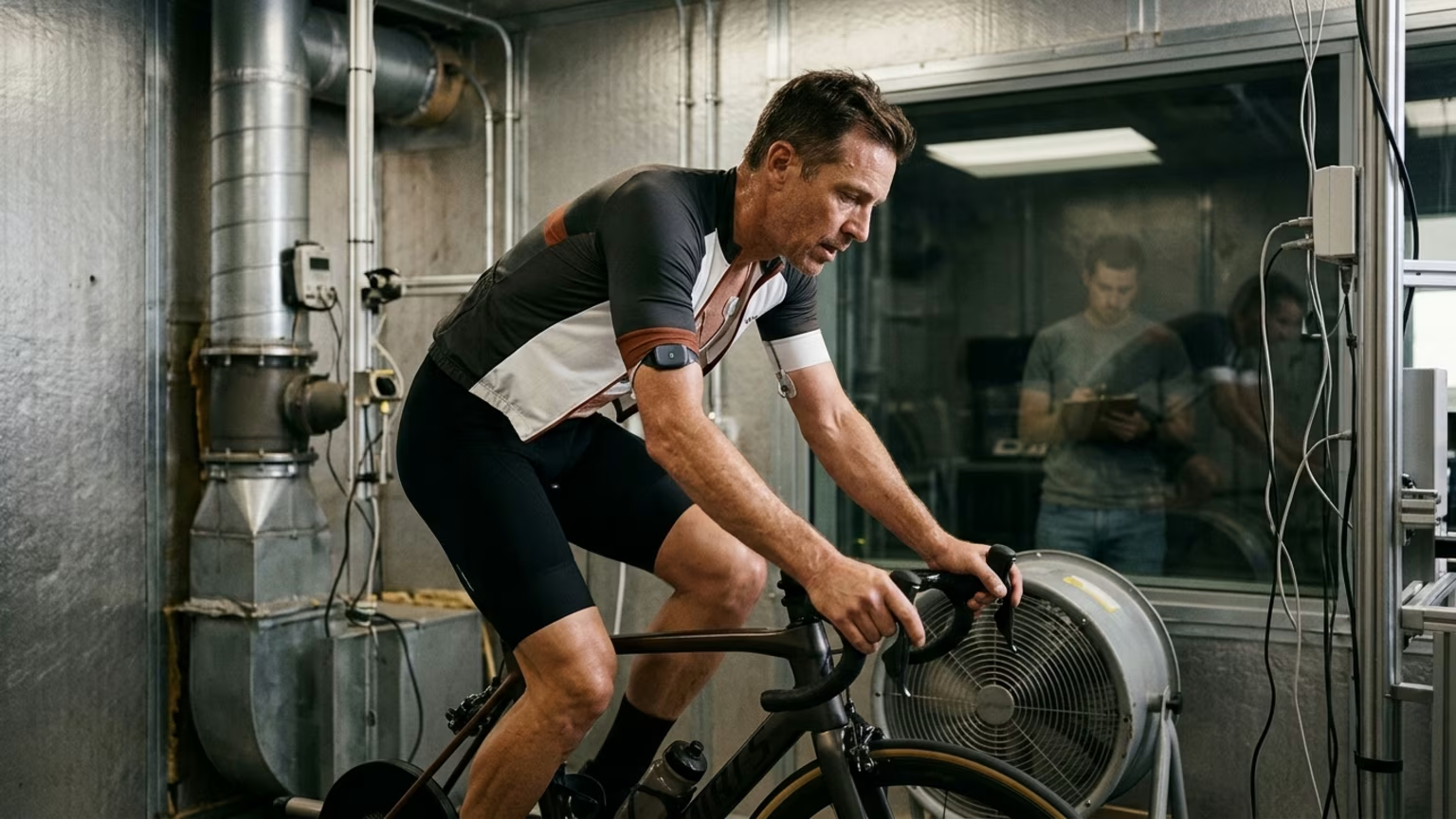
Cycling apparel brand Q36.5 used TerraXCube’s environmental chamber in Bolzano to evaluate clothing under race-like heat stress, according to an October 26 report in Bicycling. The setup combined a race-inspired Zwift workout with CORE wearable temperature monitoring. Riders’ power and heart rate were tracked alongside heat strain.
The most useful part of the report is the testing approach. Bicycling described a Q36.5 tester wearing a prototype jersey made to compare two fabrics, with multiple CORE sensors positioned around the body. Rather than relying only on how clothing felt during a ride, the evaluation brought environmental control and physiological monitoring into the same setting.
Cycling clothing is being evaluated here as part of a rider’s response to environmental stress. That makes the surrounding conditions central to the question being asked.
According to Bicycling, TerraXCube can control temperature and humidity. The facility also has control over wind, precipitation and altitude. Those capabilities give investigators a way to construct race-like conditions without depending on whatever weather happens to arrive outside.
The practical value is not simply making an indoor ride uncomfortable. It is creating a setting in which a specific apparel question can be examined. In this case, the split-fabric prototype provided a way to compare materials while collecting data around the tester’s body.
There are several distinct parts to that approach:
That is a more informative framework than judging a jersey from a temperature reading alone. It asks how the clothing behaves within a defined combination of environment and exercise. For an athlete evaluating technical apparel, that is the right kind of question to see a manufacturer asking.
Bicycling’s participant account described two related activities: riders completing the chamber session and a Q36.5 tester taking part in the instrumented fabric comparison. Keeping those activities distinct matters. A participant’s experience of riding in the chamber is not automatically a result from the clothing comparison.
The multiple sensors around the prototype were intended to help compare the fabrics’ thermoregulation. Meanwhile, tracking power and heart rate added context to the riders’ heat-strain data. The report therefore described more than a garment being worn in a hot room.
Still, the published account leaves important questions open. These are the limits to keep together when interpreting the event:
Those boundaries define what the demonstration contributes. It shows an approach to evaluating apparel under environmental stress. It does not supply a race-performance verdict.
A useful reading habit is to separate the question from the answer. Here, the question was whether fabrics could be compared using a controlled environment and wearable monitoring. A convincing answer about which garment deserves a place in an athlete’s race kit would require the comparative results and enough detail to interpret them.
For masters cyclists and triathletes, the value of this story is not a new shopping requirement. It is a clearer way to assess heat-management claims and decide which evidence deserves attention.
The same reasoning applies whether the decision concerns a jersey or the interpretation of a wearable display. Start with what was measured. Then ask how closely the testing question matches the decision being made.
A fabric comparison addresses a narrower issue than overall race suitability. Before treating a test as a reason to replace clothing, the useful questions are about the comparison itself:
These are questions about evidence quality rather than a demand for laboratory testing before every purchase. They help distinguish a documented product claim from an appealing demonstration.
For an athlete balancing performance ambitions with long-term participation, that distinction supports a measured decision. A technically interesting test can remain interesting without becoming an immediate reason to buy something.
The chamber account combined CORE monitoring with heart rate and power. That combination is the practical idea worth carrying forward: interpret the temperature estimate as part of a broader record rather than as an isolated number.
When assessing reported heat data, look for the conditions and the exercise being performed. A temperature trace without those details leaves the reader with less information about what the session actually involved.
This fits the broader task of keeping wearable metrics in context. The first question is not whether a display looks precise. It is whether the measurement and its surrounding information answer the question that matters.
The Q36.5 event examined apparel within a constructed exercise environment. An athlete planning a hot race faces a broader decision involving personal health, experience and expected conditions.
Those questions should not be reduced to the choice of a jersey. Apparel evidence can inform an equipment decision without becoming the entire preparation strategy.
For readers considering pacing and hydration in difficult weather, the useful connection is environmental context. Keep the intended race conditions in view rather than treating a chamber demonstration as a ready-made plan.
The heat-resilience literature provides a different kind of evidence from the apparel event. A 2026 review-style article in the European Journal of Applied Physiology described heat acclimation as involving repeated sessions over roughly one to two weeks, with protocols varying in duration and intensity.
That is context for understanding the process, not a prescription to copy. A race-like chamber session and a planned sequence of repeated heat exposures answer different questions. The clothing event did not establish an acclimation program.
The same article discussed how maintaining aerobic fitness may support heat tolerance across age groups. It also addressed age-related declines in maximal oxygen uptake. Together, those points support a more useful view of masters athletes than assuming age alone determines readiness for heat.
They do not establish that every athlete aged 35 to 65 will respond similarly. Individual preparation still needs to account for health, experience and conditions rather than relying on an age category.
The practical direction is to use established heat-acclimation guidance for heat preparation and apparel evidence for apparel decisions. When personal health concerns affect a heat-training or racing decision, qualified sports medicine care is the appropriate place for individual guidance.
This separation keeps the science useful. It allows an athlete to appreciate the testing method without turning a media event into a personal training protocol. It also keeps clothing claims from taking on responsibilities that belong to preparation and individual assessment.
Q36.5’s climate-chamber evaluation is a worthwhile look at how cycling apparel can be investigated under controlled environmental stress. Its strongest contribution is the combination of a defined setting, a race-inspired riding task and monitoring of the rider’s response.
For endurance athletes over 35, the practical takeaway is to ask better questions rather than make faster changes. Look for the comparison being made and the outcomes actually reported. Keep wearable estimates connected to the conditions and exercise that produced them.
There is no evidence-based requirement here to replace a jersey or alter training. The useful habit is simpler: give a testing method credit for what it examines, then reserve performance conclusions for evidence that directly supports them.

Follow ReEndure for practical insights on endurance training, recovery, nutrition and healthy aging. Stay connected for new articles, research led guidance and ideas to help you perform better for longer.


Read practical ideas on endurance training, recovery, nutrition and healthy aging to keep progressing for years to come.
Read the Blog