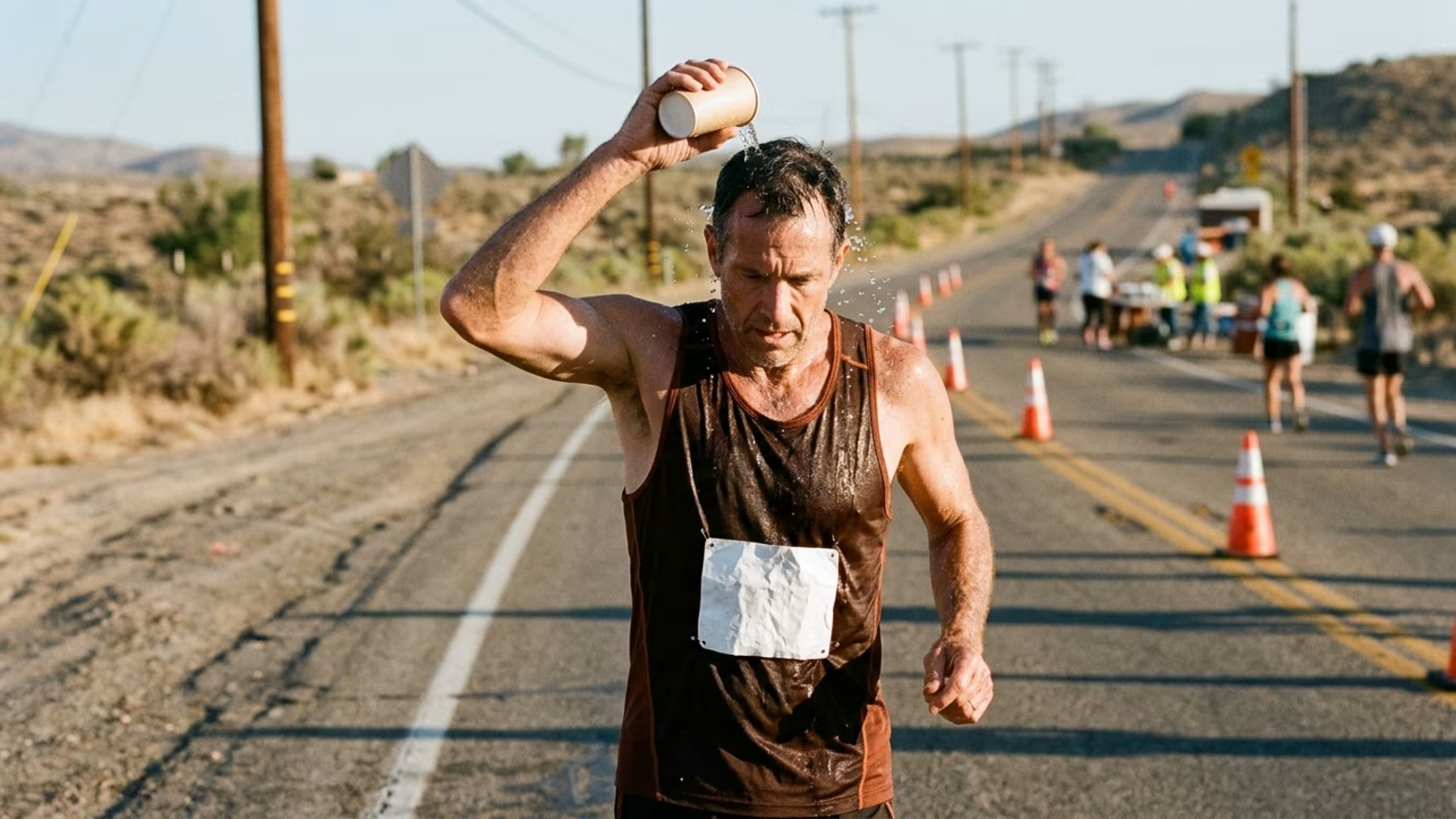

Prepare for hot races with flexible pace and power targets, realistic rehearsals, cooling safeguards, and individualized hydration planning.





How do you race well when heat and humidity make your usual targets harder to hold? Prepare for the conditions and build permission to adjust into the plan. Treat pace and power as conditional targets. Rehearse the practical details of cooling and hydration rather than expecting determination to make an unchanged plan appropriate.
Hotter conditions can make a familiar pace or power more demanding. Humidity can add to that challenge. The practical implication is straightforward: an output that feels manageable in cooler weather may no longer represent the same effort.
A coaching summary of a 2023 laboratory study describes an experiment involving 14 trained cyclists. Their 20-km time-trial performance was slower at 36°C than at 18°C or 27°C. At 36°C, doubling humidity slowed performance further.
The article also reports that temperature and humidity affected measures of heat strain. These included skin temperature and core temperature alongside heart rate. Sweat rate and discomfort were affected too. Performance was not the only thing changing with the environment.
This was a small laboratory experiment rather than a formula for predicting your finishing time. Its useful lesson is directional: conditions matter enough to justify changing expectations. It does not establish a universal pace reduction for runners or cyclists.
For an experienced athlete, the important distinction is between fitness and the conditions in which that fitness must operate. A slower split in hotter weather need not be interpreted as a failed preparation. It may instead be the appropriate expression of your preparation that day.
The evidence supports gradual heat preparation and rehearsals that resemble the competition. It does not support treating extra heat exposure as a test of commitment.
A 2026 review in Sports Medicine describes heat acclimation or acclimatization as a strategy to reduce performance impairment and heat-illness risk. Its recommendations include beginning preparation at least two weeks before a hot competition. The review describes 10 to 14 days of heat exposure, generally involving 60 to 90 minutes per day.
Those figures describe published recommendations, not a personal schedule for every reader. Much of the underlying evidence comes from laboratory studies in non-elite participants. The assembled evidence also does not establish a validated age-specific racing protocol for masters athletes. Personal decisions about heat exposure should account for health and existing training load, with qualified sports-medicine guidance where needed.
The review's most useful practical principle is to match the training environment and exercise mode to competition where possible. That shifts the question from “Did I complete heat training?” to “Did preparation resemble the demands I expect to face?”
A representative rehearsal can address several connected parts of the race:
These are practical applications of the review's recommendation to reproduce competition demands. The aim is to make the race routine familiar, not to prove how much discomfort you can tolerate.
Reendure's emphasis is on performance that remains compatible with long-term participation. That makes adjusting training around fatigue and other demands relevant to heat preparation too. A published exposure schedule should not become another obligation that overrides the rest of the training picture.
Yes. Keep the target available as a reference, but allow effort and conditions to change the output you pursue.
This is a practical inference from the cycling findings rather than a tested pacing prescription. If environmental conditions change both performance and physiological strain, insisting on an unchanged output ignores information that matters. The purpose of a target is to guide decisions rather than prevent them.
Before the race, distinguish between the performance you hope for and the decisions you intend to make. You might still have an ambitious finishing goal. The plan should also acknowledge that hotter or more humid conditions could require a different pace or power to sustain the intended effort.
A useful planning statement is: “If the conditions make my planned output harder to sustain, I will adjust the output rather than defend the split.” That preserves competitive intent while making room for what is actually happening.
The practical framework is simple:
Our guidance on making pacing plans responsive to changing conditions develops this same principle. The strongest plan is not necessarily the most detailed set of splits. It is the one that remains useful when the original assumptions no longer hold.
Feeling cooler is not proof that heat strain is under control. Cooling belongs in race preparation, but the sensation it produces should not be treated as medical clearance to continue.
The coaching article discussing the cycling experiment makes this distinction explicitly. It warns against interpreting improved cooling sensations as evidence that the body is safe from heat strain. It also warns against ignoring symptoms such as dizziness or confusion.
That creates an important boundary for a practical cooling plan. Rehearsals can establish whether the available options fit your equipment and aid-station routine. They should not teach you to dismiss concerning symptoms because a cooling measure briefly makes the effort feel more comfortable.
If dizziness or confusion occurs, seek event medical support rather than trying to protect a finishing target. Personal safety decisions belong with qualified care and event medical procedures. A cooling routine is part of preparation, not a reason to overrule those safeguards.
The experienced approach is to separate two questions: “Does this feel better?” and “Is it appropriate to continue?” The first does not settle the second.
Use an individualized hydration plan rather than a universal fluid target. The review does not justify turning one sweat measurement into a complete race-day prescription.
The Sports Medicine review states that sweat-sodium concentration alone does not determine hydration status or hyponatremia risk. It also describes the practical value of repeat testing as unsettled. Its findings on whole-body sweat-rate changes among elite athletes are inconsistent.
The useful conclusion is not that measurements have no value. It is that a measurement needs interpretation within a broader plan. A test result should inform the discussion rather than become an instruction that remains unchanged regardless of the athlete or circumstances.
For personal fluid and sodium decisions, work with a qualified sports dietitian or sports-medicine clinician. The preparation rehearsals can then address how that individualized plan fits the event rather than trying to generate a universal intake rule from the rehearsal itself.
Useful logistical questions include:
Our approach to rehearsing a repeatable long-session fueling routine provides a useful companion to this planning. The aim is a routine you understand and have practiced. Precision on paper is less useful if the routine does not fit the event.
The central lesson is not simply to expect slower racing in the heat. It is to prepare for a different set of demands without confusing rigidity with discipline.
Gradual preparation and representative rehearsals give the plan a sound foundation. Flexible pace or power targets let that plan respond to conditions. Cooling remains a practical tool rather than proof of safety, while hydration decisions remain individual.
You can keep an ambitious race goal and still revise how you pursue it. For an athlete who wants to compete for years to come, that is sound judgment rather than a compromise.

Follow ReEndure for practical insights on endurance training, recovery, nutrition and healthy aging. Stay connected for new articles, research led guidance and ideas to help you perform better for longer.




Read practical ideas on endurance training, recovery, nutrition and healthy aging to keep progressing for years to come.
Read the Blog