

Endurance athletes over 35 often waste money on recovery gadgets. Learn why mastering sleep, nutrition, and hydration drives better training adaptation.





A 2026 narrative review in Nutrients examined exactly 130 records concerning athletic recovery and training demands. This broad evaluation reveals that endurance athletes often waste time and money on complex interventions when simple habits matter far more. Instead of piling on new tools, athletes see better results by mastering basic nutrition and sleep.
Endurance athletes over 35 frequently balance ambitious race calendars with demanding professional and family lives. This balancing act makes effective recovery absolutely essential for long term athletic longevity. However, the sheer volume of available recovery advice can easily overwhelm even the most experienced competitors. Our goal is to filter out the noise and focus exclusively on evidence backed fundamentals.
Many older athletes assume that expensive tools are required to maintain a heavy training load. In an August 2026 article in Science of Running, Steve Magness and John Marcus challenge this growing recovery industrial complex. They argue that an excessive reliance on recovery products can waste money and create psychological fragility. In some cases, obsessing over digital recovery metrics can actually increase anxiety and reduce next day readiness.
The most recent scientific literature increasingly frames recovery as a structured decision problem rather than a shopping list. The Nutrients review proposes linking your recovery strategy directly to the next athletic demand. Athletes must identify their dominant physiological bottleneck before applying the minimum sufficient intervention. This deliberate approach replaces the automatic habit of stacking cold exposure, massage, and compression after every single workout.
Wearables can certainly help identify longitudinal patterns when used correctly. However, device algorithms are easily influenced by factors like posture and ambient heat. A single sleep or readiness score should never dictate whether an athlete trains or rests. We should build physical robustness rather than a dependence on increasingly elaborate technology.
Magness and Marcus treat sleep as a particularly useful canary in the coal mine. It serves as a practical indicator that an athlete's broader recovery system might be under strain. If sleep quality declines, no amount of percussion therapy or compression boots will compensate for that deficit. We must protect this foundational biological need before spending resources on external recovery gadgets.
Athletes must learn to recognize the subtle difference between standard training fatigue and systemic exhaustion. When you ignore the early signs of systemic exhaustion, it becomes increasingly difficult to reverse the damage. Adding another gadget to your daily routine will not mask the physiological cost of chronic sleep deprivation. True performance optimization requires an honest assessment of your total stress load.
Feeling rested is not always the same as completing the biological processes that build fitness. Magness and Marcus use post lifting ice baths as a prime example of an adaptation trade off. While cold exposure might reduce perceived soreness, it can blunt the signaling associated with long term training adaptation. We need to remember that some inflammation and oxidative stress are necessary for tissue remodeling and mitochondrial biogenesis.
The Nutrients review reinforces this concept by advising against indiscriminate high dose antioxidant supplementation. It notes that oral vitamin C and combined vitamin C and E can reduce cellular adaptations to endurance training. Athletes should modulate inflammation rather than attempt a blanket suppression of it. We must distinguish between an adaptation block and a congested racing schedule where rapid symptom control takes priority.
The best approach is to periodize your recovery just as you periodize your physical training. During an intense adaptation block, preserving those natural training signals is incredibly important. Conversely, during a congested racing schedule, rapid symptom control becomes the top priority. Athletes can use familiar recovery modalities during competition phases to simply feel better while minimizing psychological stress.
It is also important to carefully evaluate how you use light movement on your easiest training days. Sometimes, simply taking a complete day off is more beneficial than forcing a light spin on tired legs. True recovery requires the parasympathetic nervous system to take over and facilitate deep repair. If your active recovery session creates additional life stress, it completely defeats the purpose of the workout.
Proper fueling remains the most reliable way to bounce back from hard efforts. For years, I capped my mid ride fueling at around sixty grams of carbs per hour, convinced that taking in more would wreck my stomach. Then I read a series of recent studies on gut training and higher oxidation limits for endurance athletes.
I spent a three month base phase gradually increasing my intake up to ninety grams using a mix of glucose and fructose. The difference during my next Gran Fondo was staggering. I had a late race surge that I had never experienced before, completely avoiding the usual energy crash. This kind of consistent energy availability fundamentally changes how the body recovers from deep fatigue.
The Nutrients review emphasizes that carbohydrate restoration is critical when your next demanding session is within approximately eight hours. In those scenarios, athletes should target 1.0 to 1.2 grams of carbohydrate per kilogram of body mass per hour during the first four hours. If your next session is more than 24 hours away, this aggressive refueling process is less urgent.
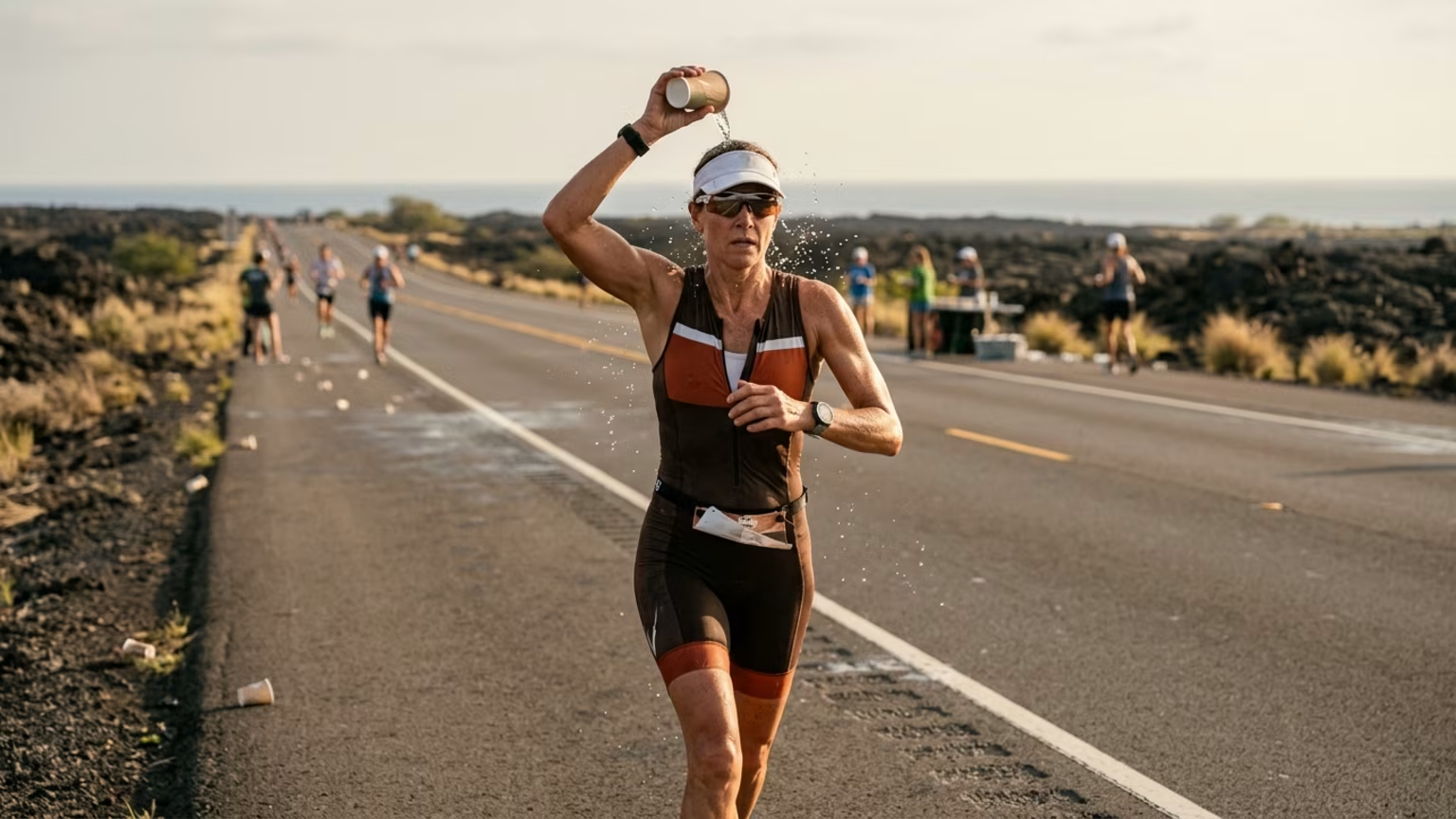
Hydration is another crucial pillar that athletes often overcomplicate with generic supplement formulas. Fluid and sodium replacement should always be individualized according to factors like body mass change and measured sweat loss. The Nutrients review cautions that plain water may be inadequate after heavy sweating. Athletes with specific clinical conditions should always seek professional guidance before implementing aggressive sodium replacement protocols.
Older endurance athletes often underestimate their need for consistent amino acid availability throughout the day. The review identifies a commonly cited protein range of approximately 0.25 to 0.40 grams per kilogram per feeding. For most adults, this equates to 20 to 40 grams of high quality protein per meal. Athletes facing anabolic resistance may need to aim for the higher end of that per meal range.
Distribution matters just as much as total daily volume. Relying exclusively on a single post workout shake is less effective than spacing your intake evenly. The review also discusses taking approximately 30 to 40 grams of casein rich protein before sleep as a useful strategy. This tactic is particularly helpful after late training sessions or when the overnight fasting interval is long.
Total energy availability is particularly important for older athletes attempting to balance hard training with busy careers. The review links low energy availability with impaired endocrine function, decreased bone health, and reduced immune resilience. Persistent fatigue, recurrent illness, or unexpected body mass changes should prompt a qualified assessment of energy availability. Adding a new recovery powder will not fix a fundamental calorie deficit.
When athletes fail to eat enough, they risk sabotaging their own health and consistency. Adequate nutrition provides the necessary building blocks for tissue repair and robust immune function. Protecting your resilience against illness requires a consistent intake of both macronutrients and micronutrients. A well rounded diet is vastly superior to any specialized antioxidant pill when it comes to long term wellness.
While basic nutrition is paramount, certain supplements can offer context dependent benefits for ambitious athletes. The review reports that a small tart cherry crossover study involving 14 participants found notable results. The participants experienced an average post eccentric strength loss of 22 percent with a placebo versus 4 percent with tart cherry. However, these small studies do not establish a universal recovery prescription for every older athlete.
Other targeted interventions show similarly selective effects. One mechanistic crossover study involved eight healthy men taking 15 grams of vitamin C enriched gelatin before intermittent loading. This protocol increased the collagen synthesis marker PINP by 153 percent at four hours, but it did not demonstrate faster rehabilitation. Another study of 10 physically active women found an interaction for peak isometric torque using blueberries with a p value of 0.047, but soreness did not decrease.
A separate pilot involving 15 resistance trained men found selective functional results but no clear comprehensive recovery advantage from collagen. In fact, muscle soreness actually increased in both groups during that specific protocol. We must view these supplemental items as highly situational tools rather than absolute daily necessities.
The broader recovery evidence base also evaluates popular interventions like creatine and omega 3 fatty acids. Creatine has established relevance for strength and lean mass, but its specific recovery benefits remain mixed and heterogeneous. Omega 3 fatty acids may have selected effects in some cohorts. However, these supplements should never substitute for sufficient energy, adequate micronutrients, or high quality sleep.
The 130 records evaluated in the recent literature ultimately point us back to the basics of minimum effective recovery. Instead of mindlessly stacking ice baths and massage guns after every run, we should match our recovery strategy to the specific demand of the next session. This might mean prioritizing simple carbohydrate replenishment today and focusing entirely on an extra hour of sleep tomorrow. By mastering these foundational habits, we build genuine athletic resilience that lasts well into our later decades.

Follow ReEndure for practical insights on endurance training, recovery, nutrition and healthy aging. Stay connected for new articles, research led guidance and ideas to help you perform better for longer.




Read practical ideas on endurance training, recovery, nutrition and healthy aging to keep progressing for years to come.
Read the Blog