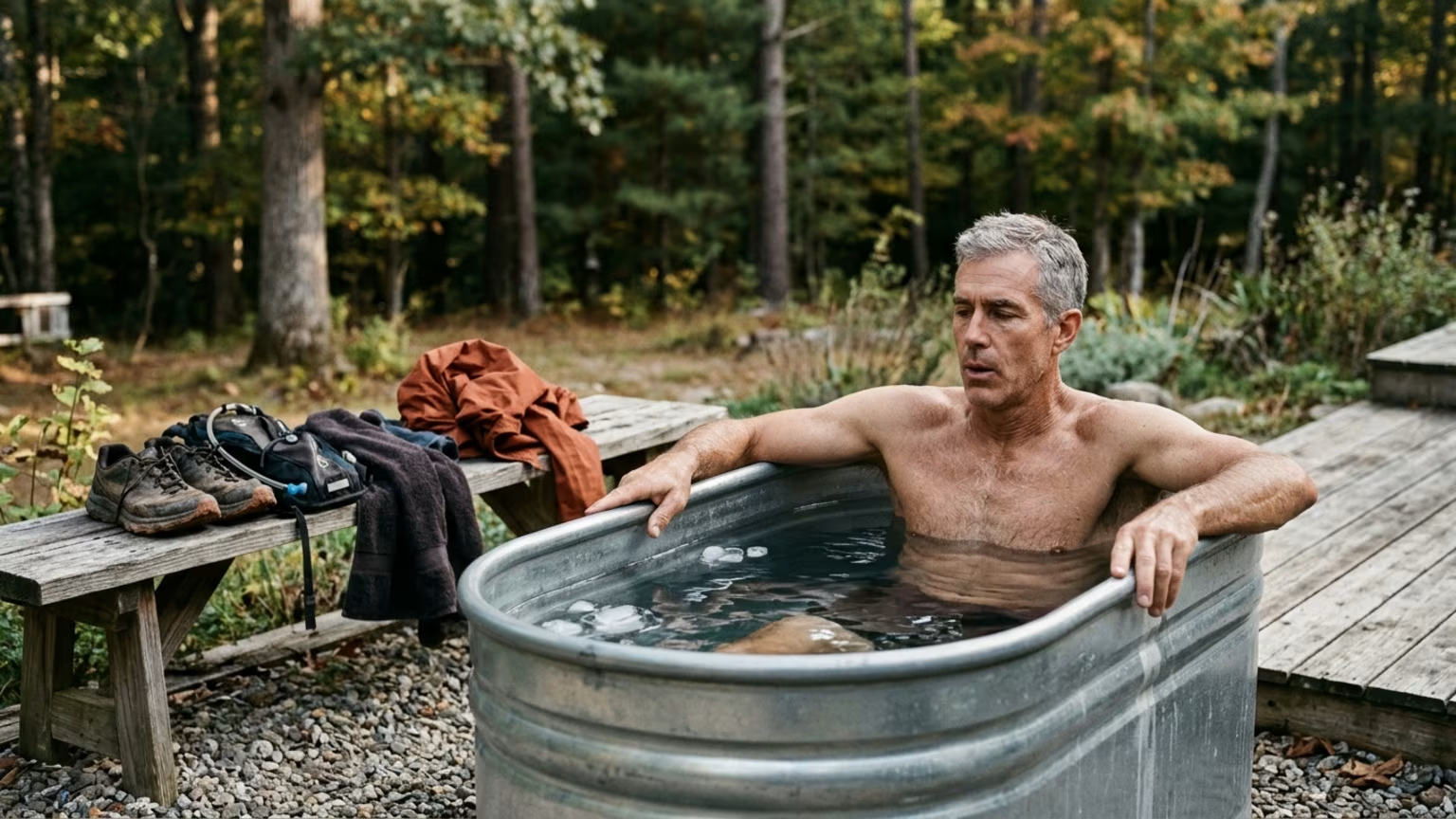

A September 2026 review suggests a narrow short-term role for cold-water immersion, not a requirement for aerobic gains or next-day performance.





On September 30, 2026, Sports Medicine - Open published an umbrella review by Berjisian and colleagues that points toward selective use of cold-water immersion. Its endurance findings separate a possible short-term performance benefit from the much larger question of improving aerobic fitness through training.
The distinction matters. One analysis found better endurance performance when testing occurred within roughly one hour after immersion. The review found no clear improvement in longer-term aerobic adaptations and no statistically significant performance advantage at six or 24 hours in that analysis.
For endurance athletes over 35, this is less a verdict on whether cold immersion is good or bad than a question about its purpose. A tool considered for another effort soon afterward should not automatically become a requirement after every workout.
The umbrella review reports that one meta-analysis of 14 studies found an endurance-performance improvement within roughly one hour of cold-water immersion. The reported standardized mean difference was 0.50.
That number is a research effect size used to summarize differences across tests. It is not a percentage improvement or a prediction of how much faster someone will race. The useful finding for an athlete is the relationship between the intervention and the timing of the performance test.
At six and 24 hours, the effects in that analysis were not statistically significant. Other analyses summarized in the review also failed to find a significant endurance-performance benefit at 24 hours. The evidence therefore does not support stretching the short-window finding into a claim about better performance the following day.
There is a separate distinction between performing again and becoming fitter. The first concerns what happens during another effort after immersion. The second concerns the aerobic changes that develop across a training period.
According to the umbrella review, cold-water immersion had no clear effect on longer-term aerobic adaptations. An apparent benefit during an immediate performance test does not establish a benefit to the training process itself.
Welltory’s coverage interprets the short-window result as potentially relevant when endurance sessions are closely spaced. It also describes cold exposure during an endurance training block as optional. That is a practical reading of the review rather than a reason to make immersion a universal recovery habit.
The central message is about matching the question to the outcome measured. “Will this help another effort soon?” and “Will this improve aerobic development?” are different questions. The review gives different answers to them.
An umbrella review brings together existing systematic reviews rather than conducting a new exercise trial. This review synthesized 15 systematic reviews with meta-analyses. Together they covered 161 unique studies and 3,210 participants.
Those totals describe the entire umbrella review. They should not be read as the size of a single endurance experiment or as the amount of evidence behind every conclusion. The short-window endurance result came from the 14-study analysis, while the longer-term endurance-adaptation evidence included one systematic review.
The authors rated the included reviews’ methodological quality as low to critically low. The certainty of evidence was mostly low to very low. A substantial collection of studies does not remove weaknesses in how those studies were conducted or combined.
The evidence base was also predominantly male. The authors specifically identified limited generalizability to women. The supplied findings do not establish a separate benefit for masters athletes or show that the response changes at a particular age.
Studies varied in exercise type and immersion protocols. Environmental conditions and the timing of outcome measurement also differed. These differences leave uncertainty about who benefits and under which circumstances.
Taken together, these limitations mean the review does not establish an optimal immersion protocol or predict an individual athlete’s response. Its findings concern cold-water immersion rather than every form of cold exposure. The appropriate translation is a targeted use case, not a standardized prescription.
For athletes aged 35 to 65, the most useful starting point is the job the recovery choice is meant to do. Supporting a training block is different from preparing for another effort shortly afterward. Treating those goals separately makes the review easier to apply without adding another obligation to an already full schedule.
Reendure’s focus is performance today alongside the ability to keep racing for years. Applied here, that means giving an immediate performance finding its proper place without turning it into a claim about long-term development.
When the priority is aerobic development, this review offers no evidence-based reason to require immersion after every endurance session. Cold-water immersion can remain optional rather than becoming a measure of how seriously an athlete takes recovery.
That is a useful practical conclusion. An intervention does not need to be harmful to be unnecessary for a particular goal. The absence of a clear aerobic-adaptation benefit is enough to reject the claim that routine immersion is essential for building endurance.
It also helps keep language precise. “I choose to include this” is different from “my training requires this.” The review supports leaving room for that distinction.
Our broader discussion of cold immersion as a recovery choice provides a place to consider the practice beyond this single performance question. The finding here is narrower: routine use is not justified by a demonstrated improvement in aerobic adaptation.
When another endurance effort follows shortly afterward, the short-window finding becomes more relevant. This is the situation in which the review offers a rationale for considering immersion as a performance tool.
The authors recommend individualizing and periodizing its use according to training phase and performance goals. They also include individual response in that recommendation. In plain language, the role of immersion can change with the purpose of the training period rather than remaining fixed throughout the season.
The practical question is therefore specific: is the aim to perform again soon, or is the aim to recover for an effort much later? The review does not support treating those situations as interchangeable.
For broader decisions about whether an effort fits the day, our approach to race-day readiness addresses a different question. A possible recovery intervention and a decision about readiness should remain separate judgments.
The distinction also matters for athletes who combine endurance work with strength or muscle-building goals. The research packet identifies resistance-training adaptation as a separate consideration in deciding when to use cold-water immersion.
That concern should not be transferred to aerobic training. This review did not establish that immersion harms aerobic adaptation. Equally, its endurance findings should not be treated as approval for routine use around every type of session.
The authors’ individualized approach offers a more coherent way to think about mixed training. Consider the purpose of the session and the outcome being pursued rather than assigning the same recovery ritual to all exercise.
For athletes thinking about strength work within a longer athletic life, that separation is especially relevant. The question is how a recovery choice fits the training goal, not whether it belongs on a universal list of required habits.
Personal health suitability is a separate decision. Questions about whether cold-water immersion is appropriate for an individual belong with a qualified healthcare professional. A performance review does not replace that assessment.
The September review offers a modest conclusion: cold-water immersion may have a role when another endurance effort follows soon. It does not establish routine immersion as a way to improve aerobic training gains or reliably improve performance the next day.
For endurance athletes over 35, the practical takeaway is to give the intervention a defined purpose. Consider the short-window finding in the setting it actually describes. Keep long-term training goals separate from immediate performance goals.
Cold-water immersion does not need to be dismissed. It also does not need to become mandatory. Selective use is the more defensible interpretation of this evidence.

Follow ReEndure for practical insights on endurance training, recovery, nutrition and healthy aging. Stay connected for new articles, research led guidance and ideas to help you perform better for longer.




Read practical ideas on endurance training, recovery, nutrition and healthy aging to keep progressing for years to come.
Read the Blog