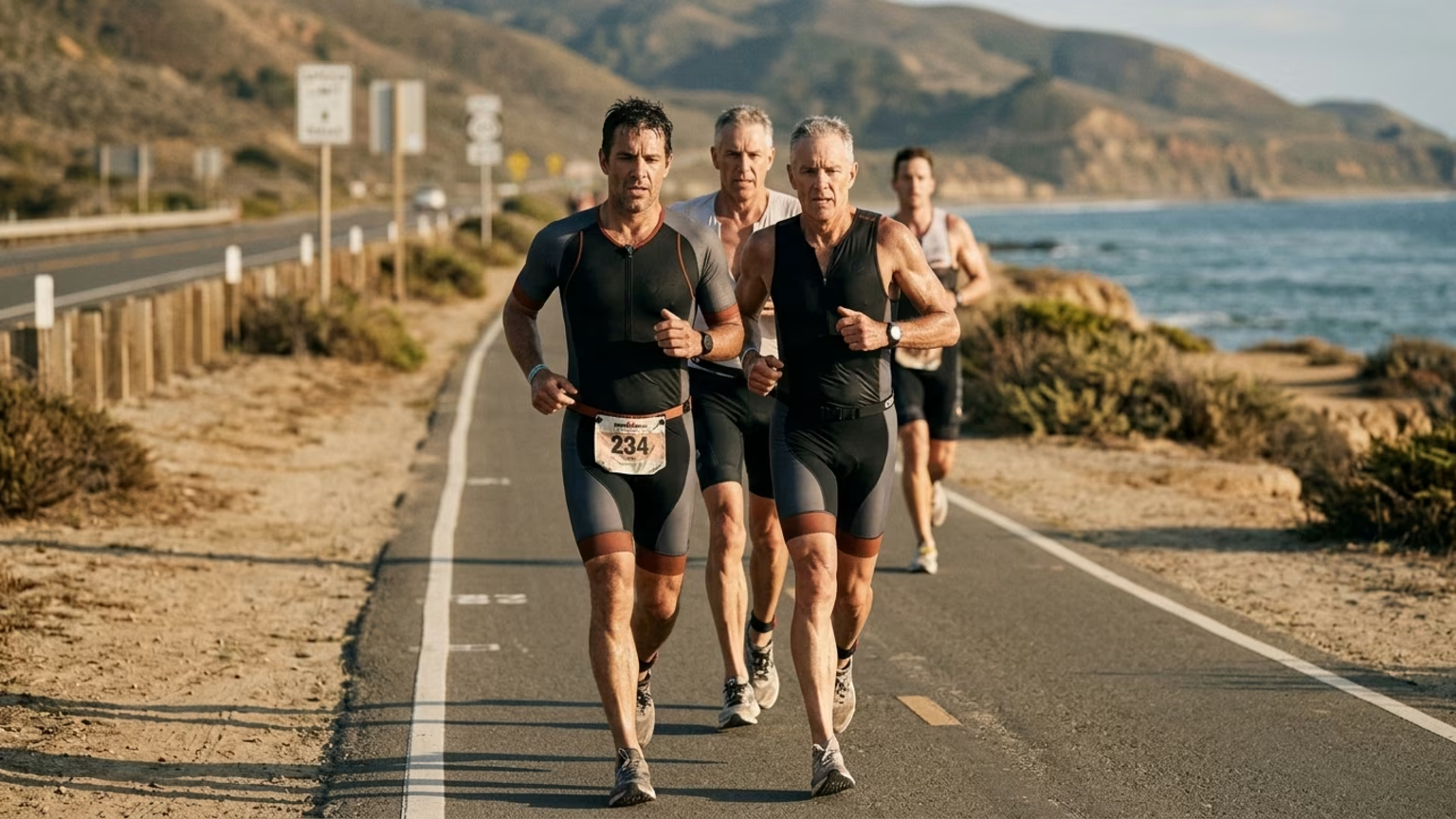

An analysis of pacing and strategy for the 2026 IRONMAN 70.3 World Championship in Nice, focusing on the technical bike course and the flat coastal run.





On September 9, 2026, Triathlon Today published a detailed tactical preview for the upcoming IRONMAN 70.3 World Championship in Nice, France. The highly anticipated event takes place across September 12 and 13. The professional women compete on Saturday, and the men follow on Sunday. This new analysis reveals a profound strategic conflict for competitors. Athletes must navigate a highly technical mountain bike course followed immediately by a completely flat coastal run.
The championship course combines standard middle-distance measurements with unique geographical challenges. Athletes face a 1.9-kilometre Mediterranean swim, a 90-kilometre bike ride, and a 21.1-kilometre run. Regional outlet Le Progrès reported that approximately 6,500 competitors are expected to participate across the weekend. The city of Nice is a familiar venue for these events, having previously hosted the 2019 70.3 World Championship and the relocated 2023 IRONMAN World Championship.
The 1.9-kilometre Mediterranean swim introduces its own tactical complexities. Operating as a single-loop course without the buoyancy assistance of wetsuits, this opening leg demands efficient form and sighting skills. Professional athletes who struggle in choppy open water may find themselves isolated before they even reach their bicycles. For age-group competitors, a non-wetsuit swim requires a calm approach to avoid early exhaustion and elevated heart rates.
However, Triathlon Today notes that the defining feature of the race is the Col de Vence. This major climb demands sustained power, while the subsequent tight turns require excellent bike handling. This terrain creates a classic tension for endurance athletes. Aggressive riders can build a massive lead on the mountain, but poor pacing could easily ruin their legs for the two-loop run.
The 90-kilometre bike ride is not just a test of physiological endurance. It is a severe examination of mechanical preparation and mental focus. Athletes must carefully select their gearing to handle the steep gradients of the Alpes-Maritimes region. Furthermore, they need absolute confidence in their braking systems for the long descent back toward the coast. A mechanical failure or a moment of lapsed concentration on these technical roads will instantly erase any time gained on the climb.
For the professional women, this course tension is amplified by contrasting preparation methods. Three-time 70.3 world champion Taylor Knibb is widely presented in race previews as the leading benchmark. Analysts suggest her formidable climbing strength and time-trial power could fragment the field early. Demonstrating her immense cycling focus, Knibb is also scheduled to compete at the UCI World Time Trial Championships just eight days after Nice.
Conversely, defending women’s champion Lucy Charles-Barclay is missing from the start list entirely. According to a Spoferan preview, she is absent because she is prioritizing her preparation for the IRONMAN World Championship in Kona. She stated that she did not want to arrive in Hawaii feeling she had left her best performance in France. This four-week gap between Nice and Kona casts a heavy strategic shadow over the start list.
Racing both events for a victory carries immense physiological risk. A Triathlete report highlights that the 70.3 and Kona double is incredibly rare in modern racing. Only four athletes have ever claimed both titles in a single year, with Daniela Ryf being the most recent to achieve this in 2018. Athletes balancing these dual ambitions must decide exactly how much risk to take on the technical Nice descents.
Reigning IRONMAN world champion Solveig Løvseth faces this exact balancing act on the French Riviera. Løvseth enters the race having already won IRONMAN Texas and IRONMAN Hamburg earlier in 2026. Her full-distance victories in those events clocked in around 8 hours and 11 minutes, remarkably finishing within two seconds of one another. However, she has raced only once since her June victory in Germany.
The top contenders arrive with very different recent racing profiles. Laura Philipp brings sharp momentum following late-August victories at IRONMAN Kalmar and the 70.3 Zell am See-Kaprun race. Meanwhile, Kat Matthews is a three-time runner-up who has not raced since Challenge Roth in July. Triathlon Today also identifies Julie Derron, Marjolaine Pierré, and Alanis Siffert as potential dark horses capable of upsetting the established hierarchy.
Start times for the event have seen conflicting preview reports. Triathlon Today lists a 07:00 CEST start for the women, while another preview indicates a 06:30 CEST start time. Competitors and spectators should therefore verify the final schedule directly with IRONMAN. Regardless of the exact starting gun, the early morning start will soon give way to demanding heat on the exposed run.
The location offers a distinct advantage to athletes who have raced the venue previously. Regional reporting confirms that Nice hosted the 2019 70.3 World Championship, along with the 2023 IRONMAN World Championship. Prior experience with the local swim conditions, the mountainous climb, and the coastal run provides a tangible tactical edge. Competitors with historical knowledge of the course can better anticipate the physical toll of the technical descents.
For ambitious endurance athletes over 35, the strategic tension in Nice provides a practical blueprint for race execution. The first major lesson involves managing intense climbs without compromising the rest of your event. German athlete Oliver Spurzem shared a highly sustainable approach for tackling the Col de Vence. He planned to ride the opening section hard, settle into a normal Ironman pace after the descent, and use the run to assess the effort.
This cautious method prevents the massive energy spikes that often destroy older runners. Older athletes must treat major elevation changes as discipline tests rather than sheer power demonstrations. A technical, hilly bike course does not guarantee a strong finish if it drains your carbohydrate stores early. You can review how to balance these efforts in our breakdown of Endurance Race Pacing Strategies Compared: Effort, Power, Heart Rate, and Terrain.
Technical descending is another crucial skill that requires specific rehearsal. The Nice course features tight turns that demand sharp braking, precise corner entry, and correct gearing choices. You cannot build this proficiency exclusively on a static indoor trainer. Veterans should actively practice high-speed handling under fatigue to safely navigate complex outdoor courses.
Executing a strong run off a challenging bike also requires deliberate physical preparation. A South African report detailed how athlete Alessandro Fanicchi used specific brick sessions to familiarize his body with the transition from cycling to running. For masters athletes, the goal of a brick workout is to rehearse the exact physiological transition sensations. It is not merely about accumulating generic fatigue across two sports.
Transitioning onto the Promenade des Anglais requires immense discipline after the demands of the bike course. The two-loop layout means athletes will receive constant visual feedback on their position relative to their competitors. This visibility can tempt runners into surging too early to close a gap or defend a lead. Maintaining a conservative effort through the first loop is essential for a strong overall finish.
The flat nature of the Nice run course presents its own deceptive challenge. A flat course can magnify small pacing errors because there are no hills to naturally moderate your speed. Athletes must establish a strictly controlled opening pace before deciding to increase their effort. You can study this exact discipline in our guide on How to Pace the First 10 Kilometres of an Ironman Marathon.
Furthermore, the Promenade des Anglais exposes runners to direct Mediterranean conditions. Triathlon Today describes this coastal run as flat and exposed, which can rapidly elevate core temperatures. Athletes should thoroughly test their hydration, carbohydrate, and cooling plans in comparable weather before race day. Understanding Adjusting Race Pacing and Individual Hydration Strategies for Competition in Severe Heat is vital for late-summer racing.
The physical toll of this specific course profile necessitates a structured recovery protocol. The eccentric muscle damage from the flat run, combined with the intense muscular tension of the mountain climbs, will require deliberate post-race care. Athletes planning to compete again later in the season cannot afford to ignore their immediate nutritional and mobility needs. You can learn more about managing this process in our analysis of How Elite Championship Racing Dictates Post Race Recovery Protocols.
Finally, age-group racers must clearly define their seasonal priorities to avoid conflicting physical demands. The four-week gap between the Nice and Kona championships forces professional athletes to choose their true objective. Masters athletes face similar calendar congestion and must separate championship ambition from general race participation. You must decide in advance if a given event is an absolute priority or simply a controlled training rehearsal.
While professional race coverage focuses heavily on elite pacing, these metrics are highly individual. The previews detail professional capabilities but do not provide validated power, heart-rate, or fueling prescriptions for older age groups. Ambitious amateurs must establish their own physiological benchmarks through rigorous personal testing. Attempting to emulate the exact power outputs of a world champion is a direct path to poor performance.
The ultimate lesson from the Nice course is that peak performance requires aligning your race-day aggression strictly with your long-term seasonal objectives.

Follow ReEndure for practical insights on endurance training, recovery, nutrition and healthy aging. Stay connected for new articles, research led guidance and ideas to help you perform better for longer.


Read practical ideas on endurance training, recovery, nutrition and healthy aging to keep progressing for years to come.
Read the Blog