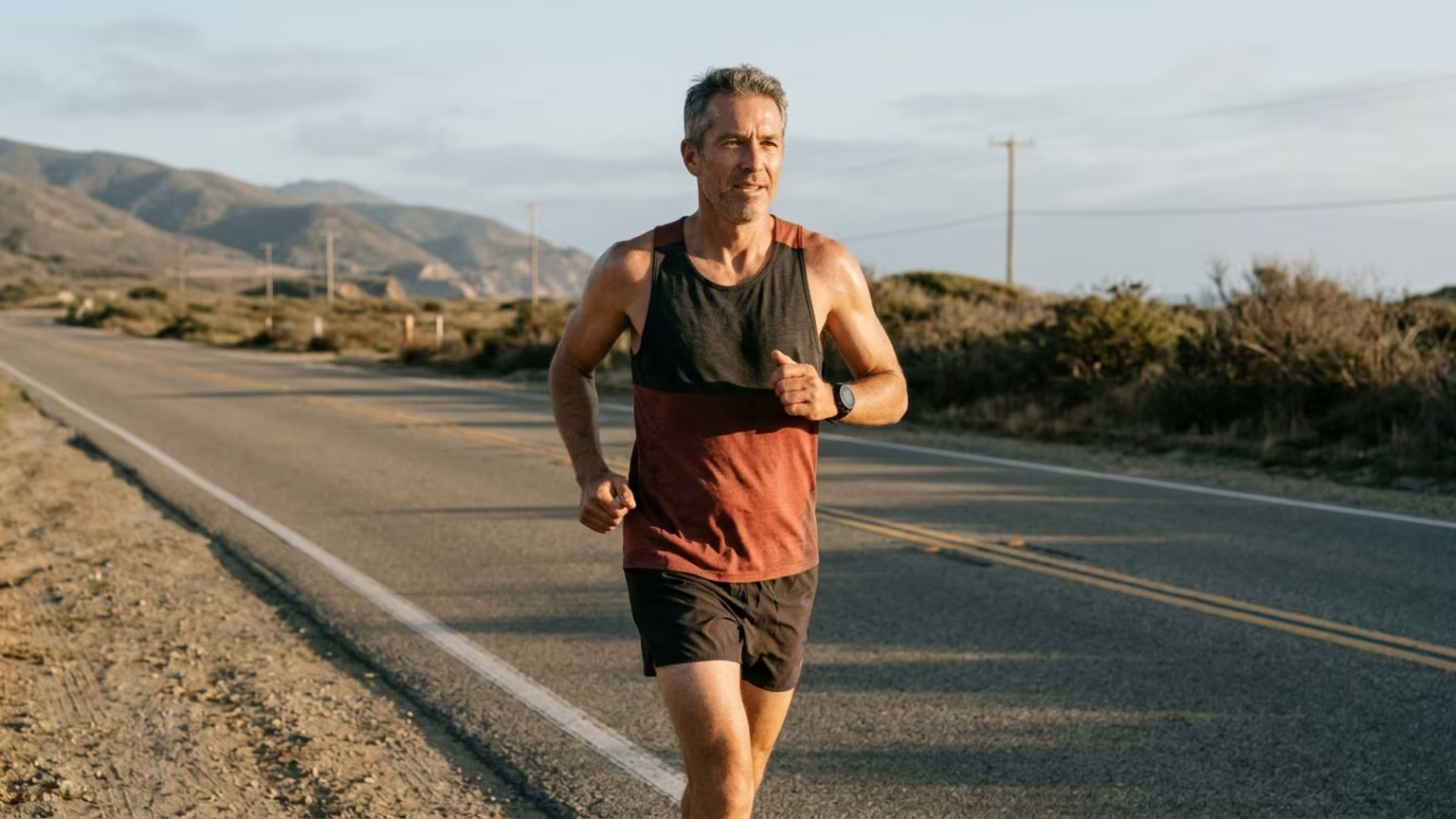

Trevor Foley describes frequent sessions, mostly aerobic work and extra sleep. Here is the measured takeaway for endurance athletes over 35.





In an October 21, 2026 article, Men’s Journal described the training routine of Trevor Foley, a 27-year-old professional triathlete. His account centers on frequent swimming, cycling and running. It also describes keeping roughly 85% of his training aerobic and making more room for sleep during demanding periods.
The striking part is not simply how much Foley trains. It is how he describes arranging that work: spreading running mileage across manageable sessions and using the flexibility of professional sport to accommodate recovery.
For endurance athletes over 35, the useful discussion starts with that relationship between workload and available time. The numbers provide context. Foley’s reasoning provides the more relevant starting point.
According to Men’s Journal, Foley aims to swim five to seven days per week and cycle six to seven days per week. He also tries to run nearly every day.
For running in particular, Foley says he prefers distributing mileage across frequent sessions rather than concentrating it into a few demanding workouts. He describes that arrangement as working better for him and helping him feel good during a training block. He also connects it with managing his injury risk.
That is a preference about how to arrange training, not just an appetite for more of it. The distinction matters when interpreting the account. Session frequency describes how often training occurs; the reported totals describe how much work those sessions contain.
Men’s Journal reports that a possible peak week for Foley might include:
These are possible peak-week figures rather than a description of every week in his season. Read together with his comments about frequency, they show the scale of the professional routine he is discussing.
The account’s central scheduling idea is more modest than those totals might suggest. Foley prefers to spread his running mileage across sessions he finds manageable. His explanation focuses on how that distribution feels within his own training block.
The Men’s Journal account says Foley keeps roughly 85% of his training aerobic. It presents that approach as part of how he builds endurance while managing the demands of swimming, cycling and running.
The percentage is an attention-grabbing detail. Yet the broader description is of a routine in which most work is aerobic, frequent sessions carry the volume and recovery receives deliberate attention.
Foley says he prioritizes extra sleep during demanding training periods. He also describes taking slower mornings when his professional schedule allows. That can mean eating breakfast before beginning training rather than waking extremely early to fit everything in.
His explanation includes an important feature of the routine: he can train throughout the day. The flexibility is part of the account, not incidental background. It helps explain how he can combine substantial training with the mornings he describes.
For readers balancing sport with employment or caregiving, this is worth noticing before focusing on the session count. Foley is describing both a training routine and the circumstances in which he carries it out.
The evidence here is practitioner testimony reported by Men’s Journal. It is not a controlled comparison of training schedules. The article does not include a separate scientist, coach or clinician evaluating whether readers should adopt Foley’s approach.
Several boundaries belong together. The account does not establish that his aerobic proportion is optimal or that frequent running reduces injury risk for other athletes. It also does not test the approach in athletes aged 35 to 65.
The reported totals are not accompanied by a complete seasonal plan. The account does not explain progression or tapering, specify the intensity of the non-aerobic work or establish how much sleep another athlete needs. Those omissions prevent turning the description into a detailed training prescription.
Race context also needs to remain separate from conclusions about the routine. Foley did not finish the 2026 IRONMAN World Championship in Kona. Triathlete reported that illness beginning the night before the race led him to withdraw. That reporting attributes the withdrawal to illness rather than to his training approach.
Taken together, the evidence supports a clear description of what Foley says works for him. Its practical value is as a prompt for assessing scheduling and recovery within an athlete’s own circumstances.
The useful translation is not to reproduce Foley’s calendar. It is to consider whether the arrangement of training matches the time and recovery an athlete actually has available.
That keeps the discussion ambitious without making a professional workload the standard. The relevant question is whether a schedule is manageable in practice, not whether it resembles an elite athlete’s week.
Foley’s preference offers a useful distinction between distributing training and accumulating more training. Those are separate decisions, even when they appear together in an athlete’s routine.
For an older age-group athlete considering the story, the first question is about the current arrangement: does concentrating training into the available sessions feel manageable? The next is about constraints: would a different distribution fit work, family and recovery more comfortably?
Those questions do not require adding sessions. They can also lead to the conclusion that the existing arrangement is appropriate. The point is to evaluate the fit rather than treat frequency itself as an achievement.
A broader view of scheduling can help keep that discussion organized. Reendure’s resource on different ways to structure a training season offers a separate planning reference beyond the details of one athlete’s week.
Foley’s comments about sleep deserve the same attention as his mileage. In his telling, demanding training periods are accompanied by greater attention to sleep. His professional flexibility can also allow a slower start to the day.
The practical question for a reader is whether training plans acknowledge the circumstances surrounding them. A calendar can contain the intended sessions while leaving the demands of work or caregiving unexamined.
Foley’s account is a reason to include those demands in the conversation. It is not necessary to reproduce his morning routine to recognize that available time is part of training planning.
When fatigue or life stress makes a schedule difficult to maintain, Reendure’s resource on thinking through changes to a planned workout addresses that broader decision. Where illness or an individual health concern is involved, personal decisions belong with qualified care rather than an athlete interview.
For athletes who want to keep competing for years, it is reasonable to be interested in how professionals organize their work. Interest does not create an obligation to match their volume or arrange life around their frequency.
At Reendure, our training guides emphasize longevity, proper recovery and progressive overload. From that perspective, the useful question is how a proposed change fits the athlete’s wider plan and long-term aims.
Foley’s story can support a thoughtful conversation with a coach about preferences and constraints. It does not require a training overhaul. Keeping an arrangement that already fits is a legitimate outcome of that conversation.
Foley describes a high-frequency IRONMAN routine built largely around aerobic work. He prefers spreading running mileage across manageable sessions and gives sleep more attention when training demands rise.
For athletes over 35, the clearest takeaway is to assess the relationship between training and the life surrounding it. Consider the scheduling idea before the workload, and give recovery a place in the same discussion.
The available evidence does not call for adopting Foley’s percentage or peak totals. It supports a more measured conclusion: his account is useful for thinking about fit, not for setting a new minimum standard.

Follow ReEndure for practical insights on endurance training, recovery, nutrition and healthy aging. Stay connected for new articles, research led guidance and ideas to help you perform better for longer.




Read practical ideas on endurance training, recovery, nutrition and healthy aging to keep progressing for years to come.
Read the Blog